
What if the £65,000 you’re prepared to spend on a single senior marketing hire only buys you one instrument when your brand actually needs a full orchestra to be heard in 2026? With the average cost of a bad hire in the UK now exceeding £30,000 according to 2024 recruitment benchmarks, the stakes have never been higher. You likely feel the strain of these rising costs and the frustration of managing disparate freelancers. It often feels like herding cats rather than driving a cohesive strategy. Finding multi-skilled talent who can deliver a measurable ROI is a constant challenge, making the debate over in-house marketing vs agency pros and cons a critical junction for your brand’s future.
Choosing your path is no longer just a line item on a spreadsheet; it’s a choice about how you’ll orchestrate your brand’s evolution. We believe in clarity over confusion and strategy over guesswork. This guide provides the strategic framework you need to decide whether to build an internal team or partner with an agency to spark sustainable growth. You’ll gain a clear roadmap for scaling your operations and an honest look at the total cost of ownership for both models so your digital presence can finally perform in perfect harmony.
Key Takeaways
- Understand why choosing between internal dedication and agency breadth is the defining strategic decision for UK brands looking to orchestrate sustainable growth in 2026.
- Evaluate the in-house marketing vs agency pros and cons, balancing the value of immediate brand intimacy against the risk of an internal “echo chamber” that misses emerging market trends.
- Calculate the true ROI of your marketing department by uncovering the hidden costs of UK hiring, including National Insurance, pensions, and the lengthy recruitment cycles currently impacting the London and Essex markets.
- Discover why a hybrid model creates the perfect harmony, allowing specialized agency experts to empower and support your existing internal team rather than replace them.
- Learn how to bridge the talent gap by leveraging master strategists who bring cross-industry insights to amplify your brand’s unique voice in a complex digital landscape.
The Marketing Dilemma: Orchestrating Growth in a Complex Digital Landscape
Building a brand in the United Kingdom requires more than just a list of tasks. It demands a masterfully conducted performance. As we approach 2026, the decision to hire an internal team or partner with an external firm has become the single most influential factor in a company’s ability to scale. The UK digital advertising market hit £29.6 billion in 2023. This 11% growth proves that the space is becoming more crowded and expensive. To cut through the noise, your strategy must function as a unified symphony rather than a collection of loud, disconnected instruments.
Many UK business leaders find themselves at a crossroads. Disparate marketing tactics fail because they lack a central conductor to ensure every channel works in harmony. When SEO doesn’t speak to PPC, and social media ignores the overarching brand narrative, the result is noise, not music. Understanding the in-house marketing vs agency pros and cons is essential for any visionary leader looking to spark sustainable growth. You must decide if you want a dedicated solo player or a full orchestra to amplify your message.
The evolution of the UK market has made specialized expertise more vital than ever. Generalists often struggle to keep pace with rapid shifts in search algorithms and consumer privacy laws. To truly master Marketing principles in a digital world, you need a roadmap that balances technical precision with creative flair. This isn’t just about filling seats. It’s about orchestrating an evolution that drives measurable success.
What is In-House Marketing?
In-house marketing involves a dedicated team or individual employed directly by your brand. These professionals live and breathe your company culture every day. They have 100% focus on your internal goals; they don’t have other clients competing for their attention. This model is often best suited for brands with high-volume, repetitive creative needs where immediate proximity to the product is vital. It offers total control over the daily workflow, but it can limit your access to the broader perspective found in the wider market.
What is a Digital Marketing Agency?
A digital marketing agency acts as an external strategic partner that provides a symphony of specialized services. Instead of one or two generalists, you gain access to a diverse talent pool including SEO experts, PPC strategists, video editors, and designers under one roof. This model offers scalable resources that adjust to your business roadmap and seasonal demands. Agencies bring a wealth of experience from different sectors, allowing them to apply proven results from one industry to spark innovation in yours. When evaluating in-house marketing vs agency pros and cons, the agency’s ability to provide a “ready-to-play” orchestra is a significant advantage for rapid scaling.
Choosing your path requires a clear vision of your future. A 2024 survey of UK CMOs found that 42% of brands are moving toward a hybrid model to capture both internal dedication and external brilliance. Whether you choose the intimacy of an in-house team or the expansive power of an agency, the goal remains the same. You must find the right voice to lead your brand to its next crescendo. Clarity over confusion and strategy over guesswork will always be the hallmarks of a successful performance.
The In-House Team: Pros and Cons of the Dedicated Soloist
Building an internal department is like hiring a dedicated soloist to play your brand’s unique melody every single day. It provides a level of focus that external partners often struggle to match. When you’re assessing in-house marketing vs agency pros and cons, the most visible advantage is the immediate physical presence of your staff. They live and breathe your corporate culture; they’re there for the 9:00 AM stand-up and the 4:30 PM emergency pivot. This proximity creates a deep brand intimacy that’s difficult to replicate from the outside.
However, this focus can lead to a narrow perspective. While a soloist masters one instrument, they might miss the evolving rhythm of the wider industry. Relying solely on a small internal group often leads to a tactical plateau where new ideas struggle to penetrate the existing company culture. You gain control, but you might lose the creative friction required for true innovation.
The Pros of Building In-House
The primary benefit of an internal team is the speed of minor execution. If you need a quick social media graphic or a small tweak to a landing page, your team is just a desk away. This instant access eliminates the lead times associated with external ticketing systems or account management layers. In a fast-moving UK market where consumer sentiment can shift in hours, this agility is a significant asset.
Beyond speed, there’s the element of cultural alignment. An internal hire understands the nuances of your brand voice because they’re part of the team building it. They aren’t just following a brand guideline; they’re living the company’s long-term vision. This deep integration ensures that every campaign resonates with your core values. You also maintain absolute control over their schedule. You decide which projects take priority without negotiating for “billable hours” or project scopes. This direct oversight allows for a highly disciplined, if sometimes limited, output.
The Cons: The Reality of the ‘Echo Chamber’
Isolation is the greatest threat to an internal marketing department. When the same four or five people brainstorm together every week, the creative well eventually runs dry. This leads to the “Echo Chamber” effect, where internal biases are reinforced and outside market trends are ignored. You can read more about how echo chambers affect marketing to understand why this stagnation kills ROI. Without the fresh air of diverse client experiences, internal teams often repeat the same safe strategies, leading to diminishing returns over time.
The financial burden is also higher than many directors realise. In the UK, a competent Marketing Manager commands a salary between £45,000 and £60,000. When you add National Insurance contributions, pension schemes, and the cost of 28 days of statutory holiday, the “unproductive” time becomes a heavy weight on the balance sheet. Weighing the pros and cons requires looking at these hidden costs alongside the lack of specialised breadth.
Skill stagnation is another silent performance killer. Digital marketing moves at a relentless pace. For instance, the Google Core Update in March 2024 fundamentally changed how SEO works. A small in-house team, bogged down by daily administrative tasks and internal meetings, rarely has the time to master these rapid shifts in PPC or search algorithms. They become generalists who can do many things adequately, but nothing at a world-class level. Managing this department also consumes roughly 15% of a senior executive’s weekly schedule; a time cost that’s rarely factored into the budget. If you find your internal rhythm is slowing down, it might be time to audit your current strategy to see where the gaps are forming.
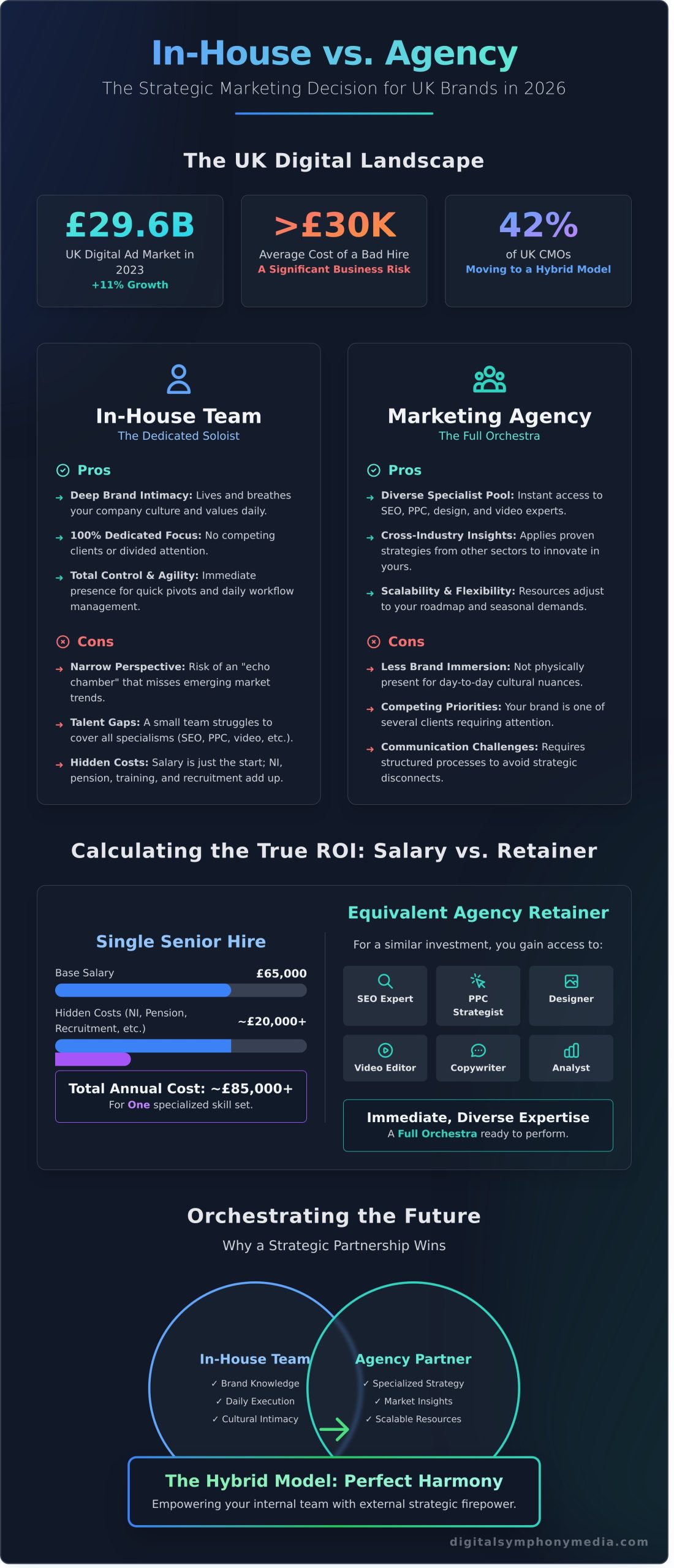
The Marketing Agency: Pros and Cons of the Full Orchestra
Hiring a marketing agency is like commissioning a professional orchestra to perform your brand’s concerto. While an in-house hire might be a talented soloist, an agency provides a coordinated ensemble where every performer is a master of their specific instrument. This collaborative approach ensures your strategy doesn’t just play a single note; it resonates across every digital channel with precision and depth.
Consider the efficiency found in deep specialization. A marketing generalist in a small UK firm often splits their day between SEO, social media, and email copywriting. They’re spread thin. In contrast, an agency SEO expert spends 40 hours a week analyzing search patterns and algorithm updates. This level of focus allowed 72% of UK marketing leaders in a 2023 survey to achieve their KPIs faster through outsourcing than by relying on internal multi-taskers. When you evaluate the in-house marketing vs agency pros and cons, the ability to deploy a specialist for a specific 48-hour campaign sprint is a clear advantage for the agency model.
Beyond the talent, agencies bring a master strategist’s perspective cultivated across dozens of industries. They don’t just see your brand in a vacuum; they apply insights from 15 other sectors to spark innovation in yours. This cross-pollination of ideas prevents the creative stagnation that often haunts internal teams after year three of a project. They also provide access to enterprise-level toolsets. A comprehensive marketing stack including SEMrush Business, Sprout Social, and advanced heat-mapping software can cost a UK business upwards of £2,100 per month in licensing fees alone. Agencies absorb these costs, providing you with data-driven clarity without the heavy overhead.
Some directors fear a lack of focus when working with external partners, but modern agencies operate as strategic extensions of your team. Weighing the pros and cons of this relationship often reveals that agencies are more accountable because their contracts depend on measurable monthly growth. They aren’t just vendors; they’re partners who help shape your brand’s evolution through disciplined, results-oriented performance.
Pros: Accessing a Diverse Talent Pool
You gain instant access to senior-level strategy without the £65,000 annual salary a Senior Marketing Manager in London or Manchester commands. Agencies allow you to amplify specific channels, like high-end video production or technical SEO, exactly when you need them. This flexibility ensures your budget is spent on active performance rather than idle capacity. Decisions remain objective and data-driven, unclouded by the internal office politics that can sometimes muffle a brand’s true voice.
Cons: The Perceived Distance
The primary challenge is the shift in communication rhythm. You won’t have “desk-side” chats; instead, you’ll rely on structured weekly syncs and project management boards. There’s also an initial onboarding period, typically lasting 30 to 60 days, where the agency must harmonize with your brand voice and internal values. Ultimately, the success of this partnership depends on the quality of the agency’s conductor, your Account Manager. Their ability to translate your vision into actionable tasks for the creative team determines the final output’s quality.
Calculating the Real ROI: Salary vs. Agency Retainer in 2026
Return on investment isn’t just a figure on a spreadsheet; it’s the rhythm of your business growth. When you evaluate the in-house marketing vs agency pros and cons, the financial picture often looks different than it did five years ago. By 2026, the cost of securing top-tier talent in the UK has reached a tipping point where a simple salary comparison no longer tells the whole story. You aren’t just paying for a person’s time; you’re funding an entire infrastructure of support, software, and stability.
The True Cost of a UK Marketing Hire
Expect to pay a premium for expertise in the current market. In 2026, the average salary benchmark for a Digital Marketing Manager in London and the South East sits between £58,000 and £72,000. However, the “sticker price” is only the beginning of the composition. Once you add 13.8% for Employer National Insurance, 3% for pension contributions, and private healthcare benefits, a £60,000 hire actually costs your business closer to £74,000. This doesn’t include the £2,500 initial hardware setup or the £4,800 annual cost for a professional software stack including Ahrefs, SEMRush, and Adobe Creative Cloud seats.
Recruitment itself has become a significant drain on resources. Finding a specialist who understands the nuances of the Essex and London markets is currently a 180-day battle for 65% of UK firms. During those six months, your digital presence remains static. This “Opportunity Cost” is the silent performance killer. While you search for the perfect candidate, your competitors are orchestrating campaigns that capture your potential market share. Training a new hire to full productivity takes another three months; meaning you’ve paid nine months of costs before seeing a single note of measurable success.
The Agency Investment Model
Choosing an agency retainer allows you to trade the burden of a single salary for a full ensemble of specialists. Instead of 100% of one generalist who may be “good” at SEO but “average” at PPC, you buy a fraction of five experts. This creates a more harmonious output where every channel is handled by a master of that specific craft. It’s the difference between a solo street performer and a perfectly tuned orchestra. You can explore how this strategic value scales by reviewing our SEO services London, where we break down how multi-disciplinary teams drive sustainable growth.
Risk management is where the agency model truly shines. Small in-house teams suffer from a “Single Point of Failure” risk. If your solo SEO manager falls ill or resigns, your entire digital strategy vanishes overnight. In contrast, an agency provides total continuity. Our team works in harmony; if one person is away, the music doesn’t stop. This reliability ensures your brand’s voice remains consistent and powerful regardless of individual staff changes. When weighing the in-house marketing vs agency pros and cons, consider that an agency retainer is a B2B expense, making it more tax-efficient and easier to scale up or down as your roadmap evolves.
Ready to orchestrate a more profitable future for your brand? Let’s build your strategic roadmap together.
Orchestrating the Future: Why a Strategic Partnership Wins
The debate surrounding internal teams versus external support often misses a vital middle ground. Successful UK businesses don’t always choose one side of the fence. Instead, 42% of high-growth companies now adopt a hybrid model. This approach allows your internal team to maintain the brand’s soul while an agency provides the specialized instruments needed to amplify it. When you weigh the in-house marketing vs agency pros and cons, the most effective solution is rarely about replacement; it is about empowerment.
Digital Symphony Media focuses on creating harmony between your existing brand knowledge and our technical precision. We don’t believe in disruptive takeovers. Our role is to act as the conductor, ensuring every channel, from SEO to paid media, plays the same tune. By removing the guesswork that often plagues internal departments stretched too thin, we move your marketing from a series of disconnected notes to a well-conducted performance that drives measurable revenue.
Moving Beyond Transactions to Partnerships
We position ourselves as your strategic partner in growth because a simple service provider relationship lacks the depth required for long-term success. Our team brings 75 years of combined experience to the table, helping UK brands evolve rather than just exist. We’ve seen how market shifts in 2023 and 2024 have impacted British consumer behavior; we use that data to help you find your unique voice. Your journey starts with a free strategy session, where we strip away the jargon to identify the specific gaps in your current performance.
Your Next Step in the Symphony
Choosing an agency is the right move when you need to scale at speed, access £10,000+ worth of monthly software tools without the overhead, or bridge a specialized skill gap that would take six months to hire for internally. While internal teams excel at day-to-day agility, an agency provides the high-level strategy and technical execution that keeps you ahead of the competition. Let’s build the future of your brand, together.
Before you make your final commitment, run through this final checklist to ensure your choice aligns with your 2025 growth targets:
- Does our internal team have the capacity to manage a full-scale SEO audit and implementation right now?
- Are we spending more than £50,000 annually on recruitment and training for roles that could be outsourced?
- Do we have access to the same level of data and competitive intelligence that a specialized agency uses daily?
- Can we pivot our strategy within 48 hours if a major search engine algorithm update occurs?
- Is our current marketing output driving a documented, positive return on investment every single month?
The balance of in-house marketing vs agency pros and cons usually tips toward a partnership when the goal is sustainable, aggressive growth. Don’t let your brand’s potential get lost in the noise of uncoordinated tactics. It’s time to refine your strategy and ensure every pound spent is an investment in your future market dominance.
Ready to see how a professional orchestration can transform your digital presence? Book a Free SEO Strategy Session With Our Team today and let’s start composing your success story.
Lead Your Brand’s Most Powerful Performance
Deciding your path forward means weighing the in-house marketing vs agency pros and cons against your 2026 growth targets. A single specialist might offer focus, but an agency provides the full-scale harmony needed to dominate modern search results. At Digital Symphony Media, we leverage over 75 years of combined online marketing experience to transform your digital presence. We don’t just guess; we’ve delivered Page 1 listings for UK brands by building bespoke roadmaps that turn every £1 of investment into measurable business growth. Your marketing shouldn’t be a collection of solo acts. It’s time to align your strategy with a partner that understands the rhythm of the UK market. We’re ready to help you lead the performance and outpace the competition. Orchestrate your brand’s evolution; Book your free strategy session today. Let’s start composing your success story together.
Frequently Asked Questions
Is it cheaper to hire a marketing agency or an in-house employee?
Hiring a marketing agency is typically 30% more cost-effective than employing a single senior specialist. A mid-level Marketing Manager in the UK earns an average salary of £45,000; when you include 13.8% Employer National Insurance and pension contributions, the total cost exceeds £52,000 annually. An agency provides a full symphony of experts for a monthly retainer often starting at £2,500, which eliminates overheads like office space, equipment, and recruitment fees.
Can an agency really understand my brand as well as an internal team?
A dedicated agency understands your brand by conducting intensive discovery sessions during the first 21 days of the partnership. We don’t just learn your colours; we orchestrate a strategy that captures your unique voice and market position. By using shared creative briefs and weekly syncs, the agency functions as a strategic ally. This collaborative approach ensures every campaign resonates in perfect harmony with your core values and long-term business vision.
What are the biggest risks of hiring a digital marketing agency?
The primary risks involve a lack of transparency and misaligned expectations regarding deliverables. When evaluating in-house marketing vs agency pros and cons, remember that 40% of UK business partnerships struggle due to poor communication. Some agencies might use a “set and forget” approach that ignores your specific ROI. To mitigate this, ensure your contract includes clear KPIs and a 90-day break clause to maintain accountability and performance standards.
How do I manage the communication between my business and an external agency?
Assign one internal lead to act as the conductor for all agency interactions to prevent conflicting instructions. Establish a consistent rhythm with bi-weekly video calls and monthly performance deep-dives. Use collaborative platforms like Slack or Monday.com to keep the project roadmap visible to everyone. Clear documentation prevents confusion and ensures your internal team and external partners work in total harmony toward your 12-month growth targets.
Should I hire an in-house person first and then an agency?
Hire an agency first to build your strategic roadmap and identify which channels actually drive revenue. This strategy allows you to scale quickly without the 6-month lead time required to recruit and train a full internal department. Once your monthly leads grow by 20% or more, you can hire an in-house coordinator. This person then manages the agency partnership, ensuring your internal culture and external marketing efforts stay perfectly aligned.
How long does it take to see results from an agency vs. an in-house hire?
Agencies typically deliver initial results within 14 days for paid media and 90 days for organic search growth. An in-house hire often requires a 3-month induction period just to understand the company landscape and tools. Agencies bring immediate access to 75 years of combined marketing experience and established workflows. This speed allows your brand to find its voice and spark engagement much faster than building a team from scratch.
What marketing tasks should I never outsource?
You should never outsource your core business vision or the final authority on brand values. While an agency can orchestrate the execution, the fundamental “why” of your company must remain internal. Your leadership team should always retain control over high-level budget approvals and proprietary product knowledge. Keeping these elements in-house ensures your strategic partner stays focused on the right goals while you maintain the ultimate authority over your brand’s evolution.
How do I measure the success of an agency partnership?
Measure success through a live dashboard of pre-agreed KPIs such as Cost Per Lead (CPL) and Return on Ad Spend (ROAS). A successful partnership should aim for a minimum 3:1 ROI within the first six months of activity. Look for qualitative improvements as well, such as a 15% increase in lead quality or more consistent brand messaging. These metrics prove the agency is driving measurable success and acting as a true strategic ally.