
One moment, your analytics are a symphony of rising clicks and conversions. The next, a deafening silence. This sudden drop in traffic isn’t just a number on a chart; it’s a direct threat to your leads, your revenue, and your peace of mind. As you stare at the decline, it’s easy to get lost in a chorus of confusing technical jargon and anxiety about hidden Google penalties. This is the moment many UK business owners ask themselves, why my website traffic dropped suddenly, and feel the weight of uncertainty.
Panic is understandable, but progress requires strategy over guesswork. In this definitive recovery roadmap, we will help you orchestrate a precise diagnostic framework to pinpoint the exact cause of the downturn. We believe in clarity over confusion. Forget the fear-you will gain a prioritised action plan designed to restore harmony to your search performance, amplify your brand’s voice, and ensure sustainable growth for 2026 and beyond. It’s time to turn down the volume on anxiety and tune into a clear strategy for recovery.
Key Takeaways
- Learn the first critical step in diagnosing a traffic drop: distinguishing a real performance issue from a simple technical glitch in your analytics.
- Discover the three primary reasons why my website traffic dropped suddenly-Technical Dissonance, Algorithmic Shifts, and Manual Actions-to pinpoint the exact cause.
- Master the use of Google Search Console as your primary diagnostic tool to identify underlying issues that can silence your brand’s online voice.
- Access a strategic roadmap to restore your site’s harmony, prioritising high-impact fixes that can reclaim your rankings quickly and efficiently.
- Understand why ongoing SEO orchestration is crucial for sustainable growth and how to bridge performance gaps during your recovery period.
The Immediate Triage: Is Your Traffic Drop Real or a Technical Glitch?
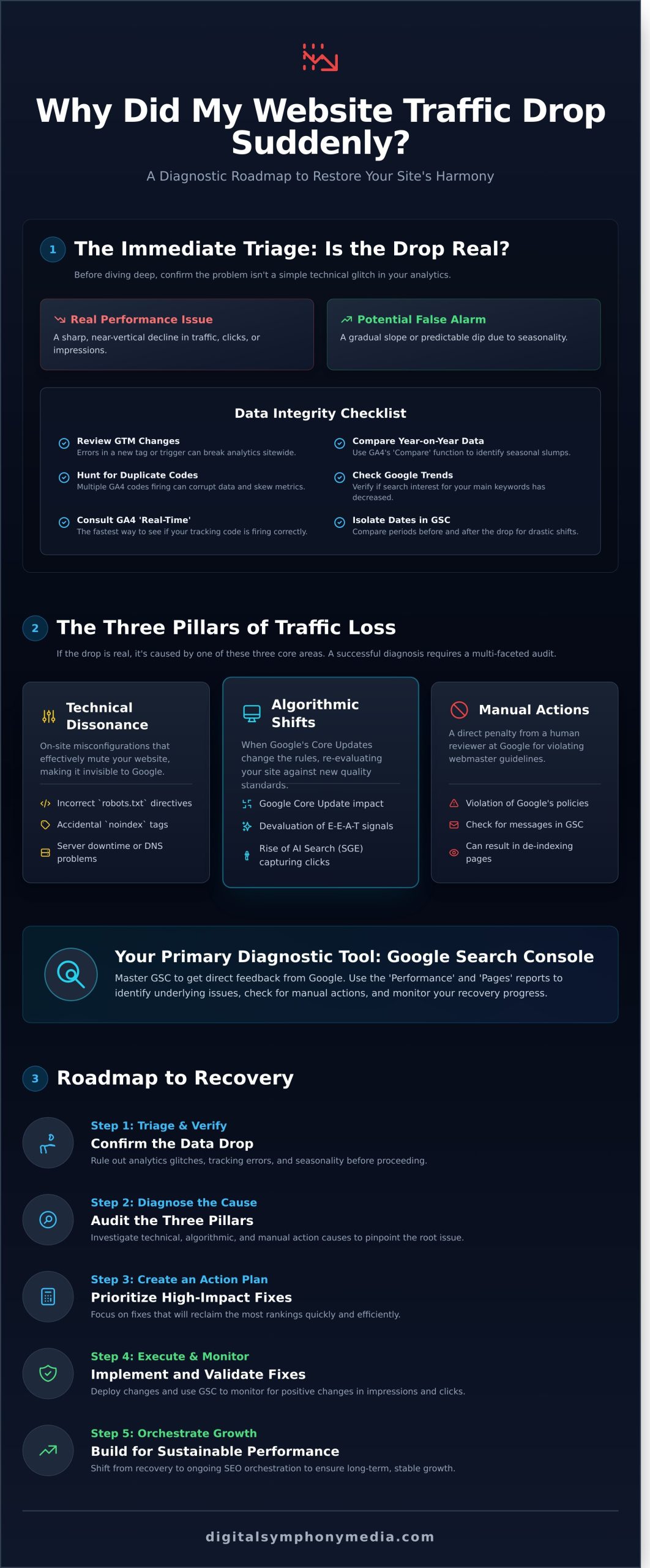
Seeing a sheer cliff-face drop in your website traffic graph can trigger immediate panic. But before you dive into complex algorithmic diagnostics, the first rule of triage is to confirm the wound is real. A sudden drop is a sharp, near-vertical decline, distinct from a gradual, sloping decrease or a predictable dip caused by seasonality. Before you ask why my website traffic dropped suddenly, you must first verify the integrity of the data you are seeing.
Often, the problem isn’t with your site’s performance but with its measurement. We call this phenomenon Traffic Dissonance: the gap between expected data and reality due to technical interference.
Checking for Tracking and GA4 Failures
Your analytics platform is the conductor of your digital symphony; if its instrumentation is off, the data it reports will be out of tune. Before assuming an algorithmic penalty or a major SEO issue, perform these fundamental checks to ensure your data is being recorded accurately:
- Review GTM Changes: Was your Google Tag Manager container recently edited or a new version published? A minor error in a tag or trigger can easily break your analytics tracking sitewide.
- Hunt for Duplicate Codes: Ensure you don’t have multiple Google Analytics (GA4) tracking codes firing on the same page. This can corrupt your data, leading to skewed metrics like artificially low session durations.
- Consult the ‘Real-Time’ Report: This is your fastest diagnostic tool. Open your website in a separate browser and watch the GA4 ‘Real-Time’ report. If you see your own visit register, data is flowing. If not, your tracking code is likely broken or missing.
Seasonal Trends vs. Algorithmic Impact
If your tracking is in perfect harmony, the next step is to look outward. Is this drop a reflection of your site’s performance, or a broader market shift? Distinguishing between the two is key to orchestrating the right response.
- Compare Year-on-Year (YoY) Data: A drop in traffic for a UK retailer in January is expected after the Christmas peak. Use the ‘Compare’ function in GA4 to view this year’s data against last year’s to identify predictable seasonal slumps.
- Check Google Trends: Has search interest for your primary keywords simply decreased? A quick search on Google Trends can reveal if fewer people are looking for your products or services, which is a market issue, not a technical one.
- Isolate Dates in Google Search Console: Use the ‘Compare’ feature in GSC to compare the period after the drop to the period before. Drastic shifts in impressions or clicks often point towards changes in how search engines perceive your site’s relevance, a core principle of search engine optimization.
The Three Pillars of Traffic Loss: Technical, Algorithmic, and Manual
When your website’s performance falters, it’s rarely due to a single, isolated issue. To truly understand why my website traffic dropped suddenly, we must approach the problem like a conductor diagnosing a symphony. The dissonance you’re hearing stems from one of three core areas: a technical failure, an algorithmic shift, or a direct manual action. Each pillar requires a distinct investigative approach to restore harmony and drive sustainable growth.
Ignoring one pillar while focusing on another leads to incomplete solutions and prolonged recovery times. A successful diagnosis requires a strategic, multi-faceted audit that examines the full score of your digital presence.
Technical Silencers: Robots.txt and Crawl Errors
This is ‘Technical Dissonance’-when a technical misconfiguration effectively mutes your website, making it inaudible to Google. A single misplaced line in your robots.txt file can instruct search engines to ignore your entire site. Similarly, ‘noindex’ tags mistakenly moved from a staging environment can de-index critical pages overnight. We also investigate fundamental issues like server downtime or DNS problems that prevent Googlebot from accessing your site, silencing your voice in the search results.
Algorithmic Evolution in 2026
Think of this as the ‘Algorithmic Shift’-when the rules of the symphony change without notice. Google’s Core Updates constantly refine how it evaluates content, placing ever-greater emphasis on E-E-A-T (Experience, Expertise, Authoritativeness, and Trust). Furthermore, the rise of AI-driven search (SGE) in the UK may be capturing traffic that once led to a click. Your content must evolve to meet these new standards and prove it is genuinely helpful for users, not just optimised for bots.
Finally, we consider the ‘Manual Action’-a direct penalty from Google’s webspam team for violating their quality guidelines. This is the most direct intervention and requires immediate, precise action to resolve. A comprehensive diagnostic audit is non-negotiable; it requires investigating every score in your digital symphony. This multi-pillar approach ensures you don’t miss one of the many potential causes for a sharp decline in website traffic while focusing solely on another. Only by examining all three pillars can we orchestrate a complete and lasting recovery.
Conducting a Diagnostic Audit: Reading the SERP Score
To understand a sudden drop in your digital performance, you must first learn to read the score: the Search Engine Results Page (SERP). Think of Google Search Console (GSC) as your conductor’s baton-the primary instrument for diagnosing where the harmony was lost. This is your first and most crucial step in creating a strategic roadmap for recovery.
Before diving into specific reports, consider if you’re creating dissonance within your own symphony. Keyword cannibalization, where two of your pages compete for the same search term, can confuse search engines and dilute your authority. Ensure each page has a unique and powerful voice. Similarly, analyse the ‘Search Appearance’ data in GSC to see if you’ve lost valuable rich snippets, which can dramatically reduce your click-through rate even without a drop in rank.
Analyse the GSC Performance Report
Your GSC Performance report is the most direct way to find out why my website traffic dropped suddenly. Focus your analysis on these key areas:
- Impressions vs. Clicks: A sharp drop in impressions signals a ranking loss. If impressions are stable but clicks are down, your title tag, meta description, or the SERP landscape itself is likely the issue.
- Filter by ‘Query’: Isolate the specific search terms that have fallen off the first page. This pinpoints exactly where your brand’s voice is no longer being heard.
- Index Coverage Report: A sudden spike in ‘Excluded’ or ‘Error’ pages indicates a technical problem is preventing Google from indexing your content correctly.
Spying on the Competition
Your website doesn’t perform in a vacuum. Sometimes, a competitor’s crescendo is the reason for your diminuendo. Evaluate the competitive landscape to see if a rival has recently changed the tune:
- Aggressive Campaigns: Has a competitor launched a massive backlink campaign or a high-profile digital PR push? Their amplified authority may have pushed you down.
- SERP Feature Changes: Check if new features like ‘People Also Ask’ boxes or video carousels are now dominating the results for your key terms, pushing organic listings further down the page.
- Outdated Web Design: Compare your site to the top performers. If your design looks dated or offers a poor mobile experience, users may be bouncing back to the SERP and choosing a competitor, signalling to Google that your result is less relevant.
The Roadmap to Recovery: 5 Steps to Reclaim Your Rankings
Once you’ve diagnosed the potential reasons why my website traffic dropped suddenly, the next movement is a disciplined recovery. This isn’t about frantic, isolated fixes; it’s about orchestrating a strategic comeback. We recommend prioritising your actions based on an ‘Impact vs. Effort’ analysis to restore harmony to your digital presence swiftly and effectively.
Here is your five-step roadmap to reclaim your rankings and amplify your voice:
- Re-submit Your XML Sitemap: Your first, high-impact step. Submitting your sitemap via Google Search Console prompts a fresh crawl, ensuring search engines have the most current and accurate map of your site’s structure. It’s a direct signal that you’re actively managing and improving your content.
- Fix Critical Errors: Address any ‘404 Not Found’ or ‘500 Internal Server’ errors identified in your audit immediately. These errors create dead ends for both users and search engine crawlers, damaging credibility and wasting crawl budget.
- Refresh Underperforming Content: Identify pages that have lost visibility. Instead of starting from scratch, amplify their value. Update statistics to be 2026-relevant, embed expert video insights, and add new infographics to reignite engagement and relevance.
- Audit Your Backlink Profile: A toxic backlink profile can silently sabotage your performance. Use a trusted tool to identify and disavow low-quality or spammy links that may be triggering Google’s quality filters.
- Optimise for Core Web Vitals: A seamless user experience is non-negotiable. Ensure your site’s loading speed (LCP), interactivity (FID/INP), and visual stability (CLS) meet Google’s standards to provide a frictionless journey for your audience.
Content Re-Orchestration
True authority comes from a well-composed content symphony. Prune thin or duplicate pages that dilute your site’s focus and offer little value. Every piece of content, from a blog post to a service page, must have a clear, strategic purpose within your SEO roadmap. By updating older articles with fresh media like ‘Video Creation’ tutorials or insightful infographics, you transform dated assets into powerful, engagement-driving instruments for your brand.
Technical Fine-Tuning
Your website’s technical foundation is the stage upon which your content performs. Focus on fine-tuning critical elements by fixing redirect loops that confuse search engines and frustrate users. Optimise every image with descriptive alt-text and implement robust schema markup to enhance visibility in an AI-driven search landscape. Finally, verify through Google Search Console that your mobile-first indexing is functioning flawlessly, ensuring a perfect performance on any device.
Executing this roadmap requires precision and expertise. If you need a strategic partner to help orchestrate your recovery, the team at Digital Symphony Media is ready to help your brand find its voice again.
Beyond the Quick Fix: Orchestrating Sustainable Growth
Diagnosing a traffic drop is a critical first step, but the real solution lies in building a resilient digital presence. In today’s ever-evolving search landscape, a ‘set and forget’ approach to SEO is a recipe for future instability. The digital ecosystem is dynamic, and your strategy must be too. True, sustainable growth comes from orchestrating all your digital channels-SEO, content, and PPC-into a single, harmonious performance that can withstand algorithmic shifts and competitive pressure.
This is about transforming a reactive fix into a proactive strategy. While we work to restore your organic rankings, expertly managed PPC campaigns can bridge the immediate traffic gap, ensuring your business maintains its rhythm and doesn’t lose valuable leads. This integrated approach, your ‘Digital Symphony’, is the key to not just recovering, but thriving long-term.
The Value of an Expert Conductor
When you’re asking why my website traffic dropped suddenly, guesswork is an expensive gamble. A professional SEO audit is an investment that is far cheaper than thousands of pounds in lost revenue. Leveraging our 25+ years of experience, we move your strategy from uncertainty to measurable success, composing a bespoke roadmap that turns complex data into clear, decisive action and tangible growth.
Your Next Strategic Move
A sudden drop in traffic is an opportunity for your competitors. The longer you wait, the more ground they gain. Don’t let a temporary dip become a permanent trend. Take decisive action now to diagnose the root cause and orchestrate a powerful recovery. We invite you to book a free, no-obligation strategy session to analyse your specific situation and outline the path forward.
Let’s orchestrate your recovery today.
Orchestrate Your Traffic Recovery
A sudden drop in website traffic is alarming, but it’s rarely the final curtain. The key takeaway is that recovery isn’t about guesswork; it’s about strategic action. By methodically diagnosing the root cause-be it technical, algorithmic, or a manual penalty-you can move from the panic of asking why my website traffic dropped suddenly to executing a precise recovery roadmap. This approach doesn’t just reclaim lost rankings; it builds a more resilient foundation for sustainable, long-term growth.
You don’t have to conduct this recovery alone. As your strategic partner, Digital Symphony Media brings over 25 years of digital marketing experience to the stage. We have a proven track record of securing Page 1 rankings for competitive UK keywords and orchestrate bespoke strategies specifically for businesses in Chelmsford and Essex. Ready to restore harmony to your digital performance?
Book Your Free SEO Strategy Session and let’s compose your brand’s comeback story, together.
Frequently Asked Questions
How long does it take for website traffic to recover after a drop?
The recovery timeline depends entirely on the cause. A simple technical fix, like removing an incorrect ‘noindex’ tag, can restore traffic within days. However, recovering from a core algorithm update requires a strategic overhaul of your content or backlink profile, which can take several months. A clear roadmap is essential to orchestrate this process, ensuring every action works in harmony to restore and amplify your site’s performance for sustainable growth.
Can a Google algorithm update cause a sudden 50% drop in traffic?
Absolutely. A major Google core update can significantly re-evaluate your site’s quality and relevance, leading to dramatic shifts in rankings. A 50% drop, while alarming, is not uncommon for sites that are negatively impacted. Understanding the focus of the update is the first step in diagnosing why my website traffic dropped suddenly. This requires a swift, strategic response to realign your website with Google’s evolving standards for quality and user experience.
How do I know if my website has been penalized by Google?
The most direct method is to check the “Manual Actions” report within your Google Search Console account. If a human reviewer at Google has applied a penalty for a specific violation of their webmaster guidelines, a notification will be present there. If this report is clear, the drop is almost certainly due to an algorithmic adjustment rather than a direct penalty. We can help you interpret these signals, providing clarity over confusion and setting a clear path forward.
What is the difference between a manual action and an algorithmic filter?
A manual action is a direct penalty from a human reviewer at Google for a clear violation, such as a manipulative link scheme. This requires you to fix the issue and submit a reconsideration request. In contrast, an algorithmic filter is an automated adjustment made by Google’s systems. There is no request process; recovery involves improving your site’s overall quality until the algorithm re-evaluates it favourably during a future update or refresh.
Will changing my website design cause my traffic to drop?
A website redesign can cause a traffic drop if not orchestrated with precision. Common issues include changing URL structures without implementing proper 301 redirects, removing key on-page SEO elements, or harming site speed. However, a strategic redesign that harmonises aesthetics with technical SEO best practices can actually boost traffic long-term. The goal is to enhance user experience while strengthening your site’s technical foundation for search engines.
Is it possible to recover from a “Helpful Content” update hit?
Yes, recovery is entirely possible, but it requires a dedicated shift in your content strategy. The Helpful Content System prioritises content created for people, not just search engines. Recovery involves a strategic audit to prune or improve unhelpful pages and a renewed commitment to creating genuinely valuable content that demonstrates expertise and satisfies user intent. This is a long-term investment in building authority and trust with your audience.
Should I stop my PPC campaigns if my organic traffic is dropping?
Not necessarily. In fact, maintaining your PPC campaigns can be a powerful strategic move. While you work to orchestrate the recovery of your organic traffic, paid search ensures your brand remains visible and continues to generate leads. The two channels work in harmony; PPC can bridge the immediate traffic gap, providing valuable data and maintaining business momentum while your long-term organic strategy is being refined and implemented.
What is the first thing I should check in Google Search Console?
Your first port of call should be the Performance report in Google Search Console. Set the date range to compare the period after the drop against a previous, stable period. This allows you to see exactly which queries, pages, and countries were most affected. This initial data provides the crucial first notes for your diagnostic symphony, helping you understand the scale of the issue and begin investigating why my website traffic dropped suddenly.