
Are you investing significant pounds into your digital marketing, only to be left questioning if it’s creating real business growth or just digital noise? When your leadership demands proof of profitability, vanity metrics like likes and impressions fall flat. It’s a common challenge: the pressure to justify every penny of your budget without a clear way to connect your campaigns to the bottom line.
This is where harmony replaces guesswork. The key to transforming this uncertainty into a powerful growth strategy is mastering how to measure digital marketing roi. In this definitive 2025 guide, we provide the conductor’s score you need. We will demystify the essential formulas, reveal the metrics that truly matter, and empower you to orchestrate a marketing symphony where every note contributes to measurable, sustainable success. Get ready to defend your budget with confidence and make data-driven decisions that amplify your impact.
Key Takeaways
- Go beyond basic calculations by mastering the core formulas that reveal the true financial performance of your marketing investments.
- Pinpoint the critical acquisition, conversion, and customer value metrics that are essential for an accurate and insightful ROI analysis.
- Adapt your approach for different platforms by learning how to measure digital marketing roi specifically for your SEO, PPC, and content marketing initiatives.
- Move from guesswork to strategic growth by identifying the common measurement pitfalls and the essential tools needed to avoid them.
What is Digital Marketing ROI? (And Why It’s Your North Star Metric)
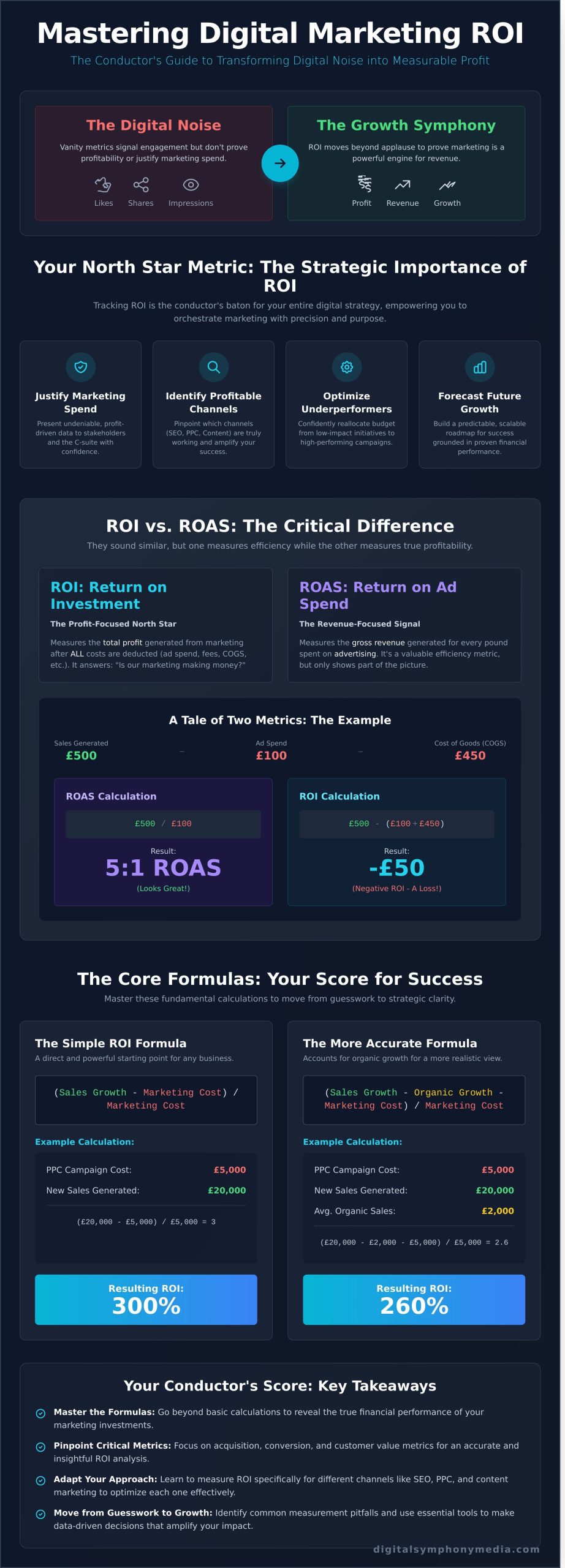
In the grand symphony of business, every marketing activity must contribute to the final composition: sustainable growth. Digital Marketing Return on Investment (ROI) is the ultimate measure of this contribution. Put simply, it calculates the profit your business earns from every pound invested in its marketing efforts. It moves beyond surface-level applause-like likes, shares, and impressions-to answer the one question that truly matters: Is our marketing making money?
While vanity metrics can signal audience engagement, they don’t pay the bills. ROI is the definitive proof that your marketing is not just a cost centre, but a powerful engine for revenue. Understanding how to measure digital marketing ROI is the foundational step in transforming your strategy from hopeful guesswork into a predictable, scalable roadmap for success. It’s the metric that secures budgets, validates your strategy, and aligns your marketing directly with core business objectives.
The Strategic Importance of Measuring ROI
Tracking ROI is more than a reporting task; it’s the conductor’s baton for your entire digital strategy. It empowers you to orchestrate your marketing with precision and purpose, ensuring every channel works in harmony. A clear view of your ROI allows you to:
- Justify marketing spend to stakeholders and the C-suite with undeniable, profit-driven data.
- Identify your most profitable channels and amplify what’s working, whether it’s SEO, PPC, or content marketing.
- Optimize underperforming campaigns or confidently reallocate your budget to higher-impact initiatives.
- Forecast future growth with a strategy grounded in proven financial performance.
ROI vs. ROAS: Understanding the Key Difference
In discussions about performance, the terms ROI and ROAS (Return on Ad Spend) are often used interchangeably, but they tell very different stories. ROAS is a revenue-focused metric that measures the gross income generated for every pound spent on advertising. It’s a valuable metric for gauging campaign efficiency, but it only reveals part of the picture.
ROI, on the other hand, is profit-focused. This approach aligns with the classic definition of Return on marketing investment, which considers the complete financial outcome by factoring in all costs associated with a campaign-including ad spend, software, agency fees, and the cost of goods sold (COGS).
Consider this example: You generate £500 in sales from a £100 ad spend. Your ROAS is a fantastic 5:1. However, if the cost of the goods sold was £450, your total cost is £550 (£100 ad spend + £450 COGS), resulting in a £50 loss. Your ROAS looks great, but your ROI is negative. This distinction is critical for making truly profitable decisions.
The Core Formulas: How to Calculate Your Marketing ROI
To orchestrate measurable success, you must first master the score. The essence of knowing how to measure digital marketing ROI lies in a few fundamental formulas that provide strategic clarity. While a complete strategy involves many elements, as outlined in Forbes’ guide on the five steps to measure marketing ROI, it all begins with these core calculations. Let’s move from a simple starting point to a more sophisticated, visionary model.
The Simple ROI Formula
This is the most direct way to see the harmony between investment and return. It’s an excellent starting point for any business.
- The Formula: (Sales Growth – Marketing Cost) / Marketing Cost
- Example: You invest £5,000 in a PPC campaign which generates £20,000 in new sales.
- Calculation: (£20,000 – £5,000) / £5,000 = 3, or 300% ROI.
For every £1 spent, you generated £3 in return. This is a powerful, straightforward metric, but it assumes your marketing was the only driver of growth.
A More Accurate Formula: Factoring in Organic Growth
Your business has a natural rhythm of growth. A more precise calculation accounts for sales you would have made anyway, preventing you from attributing all success to your campaign.
- The Formula: (Sales Growth – Avg. Organic Sales Growth – Marketing Cost) / Marketing Cost
- Example: Using the previous figures, you determine your average organic sales growth for the period is £2,000.
- Calculation: (£20,000 – £2,000 – £5,000) / £5,000 = 2.6, or 260% ROI.
This provides a more realistic view of your campaign’s direct impact.
The Gold Standard: Using Customer Lifetime Value (CLV)
The most visionary approach to how to measure digital marketing ROI is through Customer Lifetime Value (CLV). This metric forecasts the total profit a customer will generate over their entire relationship with your brand, revealing the true, long-term impact of your marketing symphony.
A campaign might acquire customers who make small initial purchases but become loyal, high-value clients over time. A campaign with a modest 100% ROI in the first month could have a phenomenal 1000% ROI when viewed through the lens of CLV, proving its strategic value for sustainable growth.
Orchestrating Your Data: Key Metrics & KPIs for ROI Calculation
A masterful symphony requires every instrument to be perfectly tuned. Similarly, an accurate ROI calculation depends on orchestrating the right data points from the very beginning. Before you spend a single pound on a new campaign, you must have tracking in place. This ensures every result can be measured against your investment, providing the clarity needed to make strategic decisions. Understanding these foundational metrics is the first step in learning how to measure digital marketing ROI with confidence.
We group these essential metrics into three core movements of the customer journey: acquisition, conversion, and value.
Acquisition & Traffic Metrics
These metrics measure how effectively you attract an audience to your digital stage. They form the top of your funnel and are the first indicators of campaign reach and efficiency.
- Unique Monthly Visitors: This gauges the total size of your audience, showing how many distinct individuals are visiting your site.
- Traffic by Source/Medium: This breaks down where your visitors come from (e.g., Organic Search, Paid Social, Email). It’s crucial for identifying which channels are performing best.
- Cost Per Click (CPC): Essential for paid advertising, this is the price you pay for each click. If a campaign costs £500 and generates 250 clicks, your CPC is £2.00. This directly informs the “Investment” part of your ROI formula.
Lead & Conversion Metrics
Once you have an audience, the next movement is converting them into prospects and customers. These KPIs measure the effectiveness of your calls to action and user experience.
- Conversion Rate: The percentage of visitors who complete a desired action, such as filling out a form, downloading a guide, or making a purchase.
- Cost Per Lead (CPL): Calculated by dividing your total campaign cost by the number of leads generated. Spending £1,000 to get 50 leads results in a CPL of £20.
- Cost Per Acquisition (CPA): This takes CPL a step further, measuring the total cost to acquire one paying customer. It’s a vital metric for understanding profitability.
Revenue & Value Metrics
This is the finale-the metrics that directly connect your marketing efforts to the bottom line. They are the ultimate measures of your marketing’s financial success.
- Average Order Value (AOV): The average amount a customer spends in a single transaction. Increasing your AOV is a powerful way to boost ROI.
- Customer Lifetime Value (CLV): The total predicted revenue a single customer will generate throughout their relationship with your brand. This is a key indicator of long-term, sustainable growth.
- Sales Revenue by Channel: By attributing sales to their original marketing channel, you can clearly see which efforts are driving the most significant financial returns.
Need help orchestrating your data to create a clear picture of performance? Let’s build your marketing roadmap.
Measuring ROI Across Your Key Marketing Channels
A successful digital symphony doesn’t play just one note. Each channel-from the steady rhythm of SEO to the powerful crescendo of a PPC campaign-contributes uniquely to your growth. Consequently, a core part of learning how to measure digital marketing ROI is adopting a tailored approach for each instrument in your orchestra. We don’t use a one-size-fits-all scorecard; we orchestrate a strategic, channel-specific analysis to reveal true performance.
Calculating SEO ROI
Search Engine Optimisation is a long-term strategic investment, not a short-term tactic. Its impact builds over time, making direct, immediate attribution its primary challenge. We measure its success by tracking organic traffic that leads to tangible conversions, such as form submissions or sales, using dedicated GA4 goals. The formula is straightforward:
(Value of Organic Conversions – Cost of SEO) / Cost of SEO
Your total SEO cost should include all investments, such as:
- Agency or consultant fees (e.g., a £2,000 monthly retainer)
- Content creation and technical optimisation costs
- Subscriptions for essential tools like Ahrefs or SEMrush
Calculating PPC ROI
Paid advertising offers immediate data, but its complexity can obscure profitability. We leverage the powerful, native conversion tracking within platforms like Google Ads and Meta Ads for granular, real-time insights. It’s crucial to distinguish between two key metrics here. Return on Ad Spend (ROAS) measures campaign-level efficiency (e.g., “For every £1 spent, we generated £5 in revenue”). True ROI, however, provides the complete picture by factoring in all costs, including ad spend, agency management fees, and creative production.
Calculating Content & Social Media ROI
Content and social media often play an introductory role in your marketing harmony, building awareness and trust at the top of the funnel. Their path to conversion is typically indirect, which is the main measurement challenge. Success here is about measuring influence. We track assisted conversions, attribute a value to leads from gated content (like an ebook download valued at £75), and monitor uplift in branded search queries. While some of the most profound value-like building brand equity-is harder to quantify, understanding these leading indicators is vital for assessing how to measure digital marketing ROI holistically.
Your ROI Measurement Toolkit: Essential Platforms & Software
To orchestrate a symphony of growth, every conductor needs their instruments. In digital marketing, your tools are the platforms that gather the data, track the performance, and ultimately reveal your success. Understanding how to measure digital marketing ROI begins with mastering this foundational toolkit. These platforms work in harmony to give you a complete, actionable view of your marketing performance.
Web Analytics: Google Analytics 4 (GA4)
Consider GA4 the central stage for your digital performance. It’s the essential hub for tracking website traffic, user behaviour, and conversion pathways. By configuring it correctly, you can monitor every note of your customer’s journey.
- Role: Provides a comprehensive overview of how users find and interact with your website.
- Must-Haves: Set up key conversion events, such as form submissions, newsletter sign-ups, or e-commerce purchases, to measure what truly matters.
- Key Reports: Focus on Traffic acquisition to see where your visitors come from and Engagement reports to understand how they behave.
- Pro Tip: Use UTM parameters on all your campaign links to precisely track which channels, campaigns, and ads are driving results.
Customer Relationship Management (CRM) Systems
A CRM is the bridge connecting your marketing efforts to your final sales data. It tracks a lead from their first interaction-like downloading an ebook-all the way to becoming a paying customer with a specific contract value in GBP (£). This is the only way to get true lead-to-revenue data.
- Role: Connects marketing-generated leads to actual sales revenue.
- Examples: Platforms like HubSpot, Salesforce, and Zoho are popular choices in the UK market.
- Importance: Without a CRM, calculating the final “Return” in ROI is based on guesswork, not concrete sales figures. It is a critical component for accurately measuring your digital marketing ROI.
Advertising Platform Dashboards
For your paid media campaigns, go directly to the source. Each advertising platform offers a powerful dashboard filled with performance data specific to your ads. This is where you get granular, real-time feedback on your ad spend.
- Role: Delivers direct performance metrics for paid campaigns on their respective networks.
- Examples: Google Ads, Meta Business Suite, and LinkedIn Campaign Manager.
- Metrics to Watch: Keep a close eye on Cost Per Acquisition (CPA), Conversion Value, and Return on Ad Spend (ROAS).
- Pro Tip: Ensure your conversion tracking pixels (like the Meta Pixel or Google Ads tag) are correctly installed and firing on key pages to guarantee data accuracy.
Common Pitfalls in Measuring ROI (And How to Avoid Them)
You now have the framework for calculating your return on investment. However, mastering how to measure digital marketing ROI means navigating the common traps that can distort your results. Avoiding these pitfalls is the final step in orchestrating a truly data-driven strategy, ensuring every note of your marketing symphony plays in perfect harmony with your business goals.
The Attribution Trap
A frequent misstep is relying solely on last-click attribution, which gives 100% of the credit for a conversion to the final touchpoint. This undervalues the crucial awareness and consideration stages driven by channels like social media or content marketing. To gain a complete view, explore multi-touch attribution models in Google Analytics 4. This allows you to see how different channels work together, honouring the entire customer journey, not just the final click.
Forgetting Hidden Costs
An ROI calculation is only as accurate as its inputs. Focusing only on ad spend provides a dangerously incomplete picture of your investment. To calculate your true ROI, you must account for all associated costs. Create a comprehensive list that includes:
- Agency fees and retainers
- Software subscriptions (e.g., CRM, SEO tools, email platforms)
- Content creation expenses (freelancers, designers, video production)
- A portion of your team’s salaries dedicated to marketing efforts
This disciplined approach ensures your ROI figures reflect genuine profitability, not an inflated metric.
Ignoring Time Lag and Customer Lifetime Value (CLV)
Impatience can be the enemy of accurate measurement. A complex B2B sale or a long-term SEO strategy won’t deliver returns overnight. Define realistic timeframes for each channel before judging its performance. More importantly, look beyond the initial transaction. A customer who makes an initial purchase of £100 could be worth £2,000 over their lifetime. Prioritising Customer Lifetime Value (CLV) over single-sale revenue provides a far more strategic and sustainable understanding of your marketing’s long-term impact.
Feeling overwhelmed by the complexities of accurate tracking? Let our experts orchestrate a clear measurement strategy for you.
Orchestrate Your Growth with Clear ROI
Mastering how to measure digital marketing roi is the difference between guessing and growing. It’s about more than just a formula; it’s about establishing your North Star metric, meticulously tracking the right KPIs, and using the right tools to gain a clear view of your performance. By avoiding common pitfalls, you transform data from a confusing noise into a powerful symphony of insights that guides every strategic decision, ensuring every pound you invest works harder for your business.
At Digital Symphony Media, we act as strategic partners, not just service providers. With over 25 years of combined experience and a proven track record of driving measurable growth for our clients, we know how to conduct a marketing strategy that truly delivers. Stop navigating the complex data alone. Ready to orchestrate your marketing for measurable success? Book a free strategy session with us today.
Let’s compose your success story, together.
Frequently Asked Questions
What is a good digital marketing ROI for a small business?
A strong benchmark for a UK small business is a 5:1 ratio-£5 in revenue for every £1 spent. However, a “good” ROI is not a single number; it’s a strategic target unique to your business. It depends entirely on your profit margins and growth stage. A high-margin consultancy can thrive on a 3:1 ROI, while a low-margin e-commerce store may need a 10:1 ratio to achieve sustainable growth and profitability.
How often should I be calculating and reporting on marketing ROI?
For tactical adjustments, we recommend calculating and reporting on your marketing ROI monthly. This frequency allows you to fine-tune campaigns and reallocate budget effectively. However, for a true strategic overview, you should conduct deeper analysis quarterly and annually. This broader perspective accounts for longer sales cycles and reveals overarching trends, ensuring your marketing symphony stays in perfect harmony with your long-term business goals.
How can I measure the ROI of brand awareness or top-of-funnel campaigns?
Measuring the direct ROI of top-of-funnel campaigns is a common challenge. Instead of direct revenue, we focus on orchestrating growth through leading indicators. Track metrics like increased branded search volume, website traffic growth, social media engagement, and newsletter sign-ups. The key is to correlate these uplifts with future sales over time. This approach is fundamental to understanding how to measure digital marketing ROI holistically, acknowledging that awareness builds the audience for future conversions.
What’s the most common mistake businesses make when measuring ROI?
The most common mistake is focusing solely on last-click attribution. This model gives 100% of the credit for a sale to the final touchpoint, ignoring the entire customer journey that came before. It undervalues the crucial awareness and consideration stages, such as an initial blog post or social media ad. To get an accurate picture, businesses must adopt a multi-touch attribution model that assigns value across the entire path to purchase.
Can I calculate marketing ROI without a CRM system?
Yes, you can calculate marketing ROI without a dedicated CRM, but it requires meticulous manual tracking. You would typically use spreadsheets to log leads from various sources and manually connect them to sales data. While possible, this method is prone to error and offers limited insight. A CRM automates this process, providing clear, reliable data for accurate ROI calculation. It’s a foundational instrument for any business serious about orchestrating measurable growth.
How does a long sales cycle affect ROI calculation?
A long sales cycle demands a longer measurement window. Calculating ROI on a monthly basis for a B2B service with a six-month sales cycle will provide a misleading and incomplete picture. To measure accurately, your reporting period must match or exceed your average sales cycle length. In the interim, focus on leading indicators like marketing qualified leads (MQLs) or demo requests. These metrics provide vital early feedback on campaign performance while you await the final revenue data.