
Your marketing should be a perfectly orchestrated symphony, with every channel working in harmony to amplify your brand’s voice and drive measurable growth. But what happens when the music is off-key? Instead of a powerful performance, you get dissonance-confusing reports, lackluster results, and a nagging feeling that your investment is being wasted. This growing frustration is one of the clearest signs of a bad marketing agency, a partner who simply isn’t playing from the same sheet music as your business.
Feeling locked into an underperforming contract is a difficult position for any business leader. But you don’t have to guess whether your concerns are valid. In this article, we’ll reveal the seven critical red flags that signal your agency relationship is out of tune. Consider this your definitive checklist to evaluate your partnership, empowering you to either fix the harmony or confidently find a new conductor to orchestrate your success.
Key Takeaways
- Understand why a lack of communication harmony is more than an annoyance-it’s a critical threat to your campaign’s success.
- Learn to distinguish between a bespoke growth strategy and a generic, one-size-fits-all template that stifles results.
- Discover how to identify the key signs of a bad marketing agency, from vanity metrics to a clear failure to drive tangible business growth.
- Develop a clear action plan for addressing red flags, helping you decide whether to repair the partnership or find a new strategic ally.
Communication Breakdown: When a Partnership Lacks Harmony
A strategic partnership with a marketing agency should feel like a perfectly orchestrated symphony-each instrument playing in harmony to amplify your brand’s voice. This collaboration is built on a foundation of clear, consistent communication. When that harmony is replaced by silence or confusion, it is one of the most critical signs of a bad marketing agency. The fundamental purpose of what is a marketing agency is to act as a growth partner, but a breakdown in dialogue leads directly to missed opportunities, strategic misalignment, and a wasted marketing budget that can run into thousands of pounds.
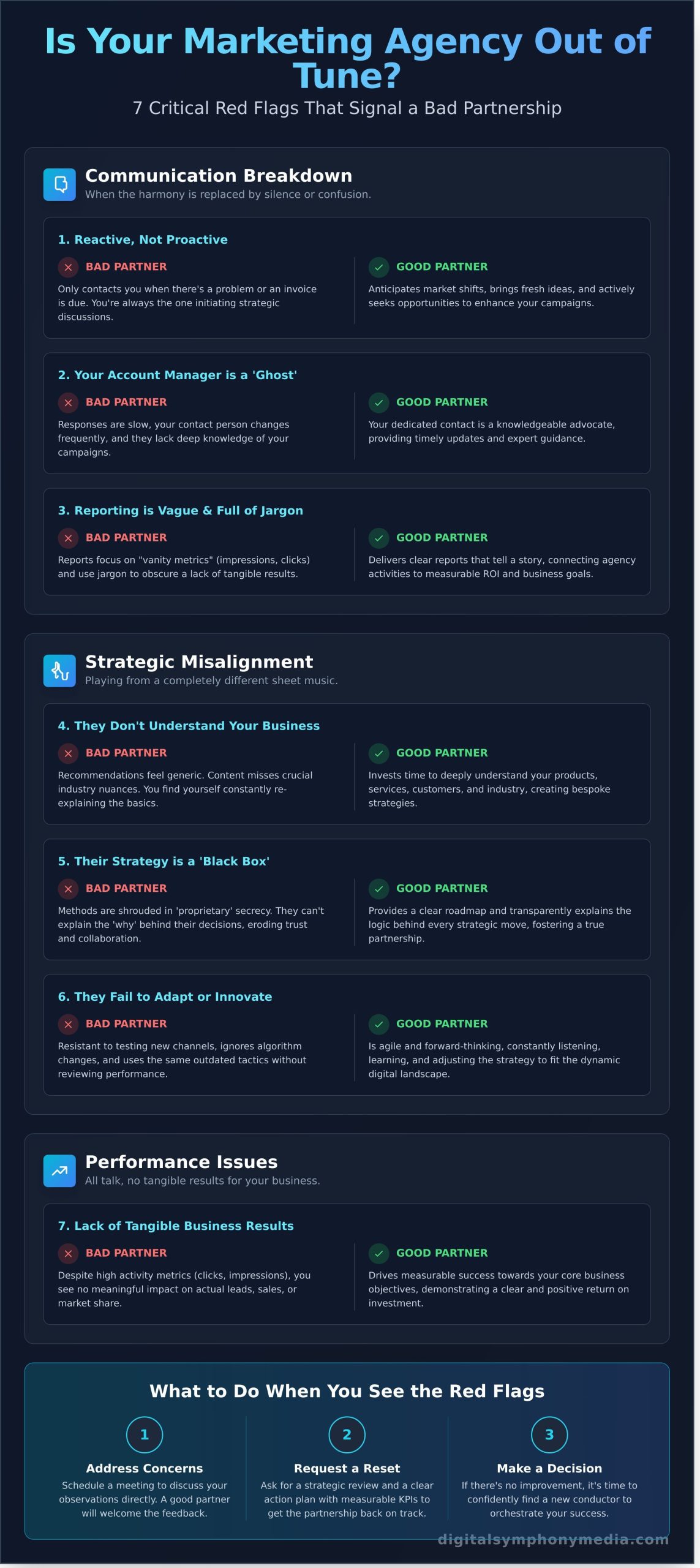
They’re Reactive, Not Proactive
Does it feel like you’re always the one initiating contact? A partner who only reaches out when a problem arises or an invoice is due isn’t driving your strategy forward; they’re just keeping the lights on. A true strategic ally anticipates market shifts, brings fresh ideas to the table, and actively seeks opportunities to enhance your campaigns. The sound of silence from your agency should be a cause for concern, as it signals a reactive mindset rather than a proactive commitment to your growth.
You Have a Dedicated ‘Ghost’ for an Account Manager
Your dedicated point of contact should be your advocate and expert within the agency. However, if getting a timely response is a constant struggle, or your account manager seems to change every quarter, it points to significant internal issues. An account manager who lacks in-depth knowledge of your campaign’s status or goals is a major red flag. This disorganisation suggests your account isn’t a priority, leaving your strategy without a dedicated conductor to guide it.
Reporting is Vague and Filled with Jargon
Data should empower, not confuse. A common tactic of underperforming agencies is to deliver reports filled with vanity metrics-like impressions or clicks-without connecting them to your actual business objectives. They use complex jargon to create a fog of activity, obscuring a lack of real progress. A great report tells a clear story, demonstrating exactly how agency activities are driving measurable success and delivering a tangible return on your investment (ROI).
Strategic Misalignment: Playing from Different Sheet Music
A successful marketing campaign is a finely orchestrated symphony, with every instrument playing in perfect harmony towards a single objective: your business growth. It requires a bespoke strategy, meticulously composed to amplify your unique brand voice. However, one of the most telling signs of a bad marketing agency is their tendency to play a pre-recorded tune for every client. This one-size-fits-all approach inevitably leads to generic campaigns, wasted budget, and a performance that fails to resonate with your audience. Your agency’s strategy must be perfectly in tune with your business goals, not just a convenient template from their playbook.
They Don’t Understand Your Business or Industry
A true strategic partner invests the time to learn the unique composition of your business. If they don’t, the resulting marketing will be jarringly out of tune. You find yourself constantly correcting their work or re-explaining the basics because they see you as just another contract, not a partner. Watch for these red flags:
- They haven’t invested time to deeply understand your products, services, or ideal customers.
- Their content and campaigns miss the mark on crucial industry nuances and terminology.
- Their recommendations feel generic and could apply to any business in any sector.
Their Strategy is a ‘Black Box’
Clarity and collaboration are the cornerstones of a powerful partnership. An agency that shrouds its methods in secrecy, claiming they’re ‘proprietary’, is not a partner but a gatekeeper. You should have a clear roadmap and understand the logic behind every move. This lack of transparency is one of the most frequently cited reasons to fire your marketing agency because it prevents genuine collaboration and erodes trust. You should be concerned if they can’t explain the ‘why’ behind their strategic decisions or provide a clear plan for the coming quarter.
They Fail to Adapt or Innovate
The digital landscape is a dynamic concert hall, not a static recording. An agency that plays the same outdated tune on repeat will quickly fall flat. A modern market requires an agile and forward-thinking marketing partner who is constantly listening, learning, and adjusting the score. This failure to evolve is one of the most damaging signs of a bad marketing agency. Be cautious if your agency is resistant to testing new channels, ignores algorithm changes, or uses the same tactics for months without reviewing performance.
Performance Issues: All Talk, No Tangible Results
Ultimately, you engage a marketing agency to achieve clear business objectives. Whether your goal is to generate high-quality leads, drive sales, or amplify your market share, the partnership must be built on a foundation of measurable success. While any reputable agency will tell you that guaranteed results are a fantasy, a complete lack of progress is a reality you cannot afford to ignore. If the initial energy and promises have faded into a period of stagnation, it’s time to look closer.
Your Key Metrics Aren’t Improving
After a reasonable onboarding and implementation period, you must see a positive trajectory. If the needle isn’t moving, it’s a critical issue. A true strategic partner provides a clear roadmap for growth, but a failing one will offer excuses. Watch for these warning signs:
- Stagnant Performance: Key metrics like website traffic, lead volume, and online sales remain flat or, even worse, are in decline.
- Static Search Rankings: Your website has made no meaningful progress in search engine results for your most important target keywords.
- Rising Costs: Your cost-per-acquisition (CPA) is increasing, costing you more for each new customer without a corresponding increase in their value.
- No Action Plan: When questioned about the lack of results, the agency has no data-backed plan to pivot or improve their strategy.
They Take Credit for Everything, and Blame for Nothing
In a successful partnership, accountability is shared. One of the most telling signs of a bad marketing agency is a culture of blame-shifting. They are quick to attribute any positive fluctuation-even a seasonal sales bump you see every year-to their brilliant efforts. However, when performance dips, the fault suddenly lies with Google’s algorithm, a tough economy, or even your own team’s efforts. A genuine partner takes ownership of both wins and losses, using performance data not as a shield, but as a tool to learn, adapt, and refine the strategy in harmony with your goals.
You Don’t Own Your Accounts or Data
This is a non-negotiable aspect of a healthy client-agency relationship. Your business data is one of your most valuable assets. If an agency sets up your Google Analytics, Google Ads, or social media advertising accounts under their own ownership, they are effectively building a wall around your history. This lack of transparency is one of the biggest red flags to watch out for, as it holds your data hostage and makes a future transition incredibly difficult. You must always have full administrative access to, and ownership of, all your digital marketing accounts and the data within them.
What to Do When You See the Red Flags
Identifying the signs of a bad marketing agency is the crucial first step, but taking decisive action is what truly protects your investment and drives your business forward. Not every misstep warrants ending the relationship; however, a pattern of poor performance requires a structured response. Your goal is to restore harmony to your marketing efforts and achieve the measurable success your business deserves.
Step 1: Document Everything and Schedule a Meeting
Before you can address the dissonance, you need a clear record of the issues. Vague complaints are easily dismissed, but data-driven concerns demand attention. Your first move is to orchestrate a formal review.
- Gather specific evidence: Collate examples for each red flag. This could include reports showing declining traffic, email chains with missed deadlines, or a lack of strategic input on calls.
- Request a leadership meeting: Escalate the conversation beyond your day-to-day account manager. A meeting with agency leadership signals the gravity of the situation.
- Present your case calmly: Lay out your documented concerns clearly and professionally. The objective is not to assign blame, but to find a path to a solution.
Step 2: Set Clear, Measurable KPIs and a Timeline
A committed partner will welcome the opportunity to course-correct. The most effective way to manage this is by co-creating a performance improvement plan. This gives the agency a fair chance to prove they can deliver.
Agree on a 30 to 60-day roadmap with specific, measurable KPIs that directly impact your business goals-such as lead generation targets, cost per acquisition (CPA), or organic ranking improvements. Schedule weekly check-ins to monitor progress and ensure accountability. This process will quickly reveal whether the agency is capable of turning things around or if the initial problems were symptomatic of a deeper issue.
Step 3: Prepare to Transition to a New Partner
If the performance plan fails to yield significant improvement, it’s a clear signal that it’s time to move on. Recognising these persistent signs of a bad marketing agency means you can confidently begin your search for a new partner without regret. Start by reviewing your contract for termination clauses and required notice periods.
Begin researching agencies that demonstrate a commitment to strategy, transparency, and collaboration. Your marketing should be a perfectly orchestrated symphony, not a source of constant friction. It’s time to find a partner who can help your brand find its voice. See what a true strategic partnership looks like.
Orchestrate Your Success with the Right Partner
Recognising when your marketing partnership is out of tune is the crucial first step towards creating true harmony for your brand’s future. Persistent communication breakdowns that leave you in the dark, a lack of strategic alignment with your core business goals, and a failure to deliver tangible results are more than just minor issues; they are definitive signs of a bad marketing agency that can actively hinder your growth.
Your business deserves more than just background noise; it deserves a dedicated strategic partner committed to composing a masterpiece of measurable success. With over 75 years of combined experience, our team has a proven track record in orchestrating powerful SEO, PPC, and Web Design strategies that deliver a standing ovation of results. We believe in clarity over confusion and relationships over transactions.
Feeling unheard? Let’s orchestrate a strategy that drives real growth. Book a free consultation. It’s time to find a partner who can amplify your voice and lead your brand to its crescendo.
Frequently Asked Questions About Marketing Agencies
How long should you give a marketing agency to see results?
The timeline for results depends entirely on the strategy. For instance, a well-orchestrated PPC campaign can show initial results within the first month, while SEO is a long-term investment, often requiring 4-6 months to gain meaningful traction. A reliable agency will establish a clear roadmap with realistic milestones and key performance indicators (KPIs) from the outset, ensuring you know what success looks like at every stage of the partnership.
What’s the difference between a bad agency and a campaign that’s just slow to start?
The key difference is communication and transparency. A slow start is often accompanied by proactive updates, detailed reporting on foundational work, and a clear explanation of the timeline. In contrast, one of the clearest signs of a bad marketing agency is radio silence. If you’re met with vague answers, missed reporting deadlines, and a lack of demonstrable activity, it points to a deeper issue than a simple delay in campaign momentum.
Is it normal for my account manager at an agency to change?
Yes, changes in account management can be a normal part of business due to promotions or staff turnover. However, a professional agency will manage this transition seamlessly. You should expect a formal introduction to your new point of contact and a structured handover process that ensures no loss of strategic momentum. Frequent, unannounced changes or a feeling of being passed around without care are red flags that suggest internal instability within the agency.
What are the biggest red flags to look for BEFORE signing a contract with an agency?
Before you commit, watch for unrealistic promises like “guaranteed number one rankings on Google.” Other major red flags include a vague or non-existent strategy, high-pressure sales tactics, and an unwillingness to provide client references or detailed case studies. A true strategic partner will focus on understanding your business and co-creating a bespoke roadmap for sustainable growth, not on making impossible guarantees to close a deal quickly.
How do I switch marketing agencies without losing momentum or data?
A smooth transition is orchestrated through ownership and planning. First, ensure you have administrative access and ownership of all your digital assets, including your website, Google Analytics, Google Ads, and social media accounts. Before serving notice, ask your new agency to conduct an audit. Then, coordinate a handover period where crucial data and insights can be transferred. This ensures your new partner can pick up the baton without missing a beat, maintaining your brand’s market rhythm.
Can I get out of my marketing agency contract if they are underperforming?
In the UK, your ability to terminate a contract depends on its specific terms. Review your agreement for a termination or break clause, which will outline the required notice period and any conditions for early cancellation. If the agency has failed to meet specific, contractually agreed-upon KPIs, you may have grounds for termination due to a breach of contract. It is always wise to seek professional legal advice to understand your precise rights and obligations before taking action.