
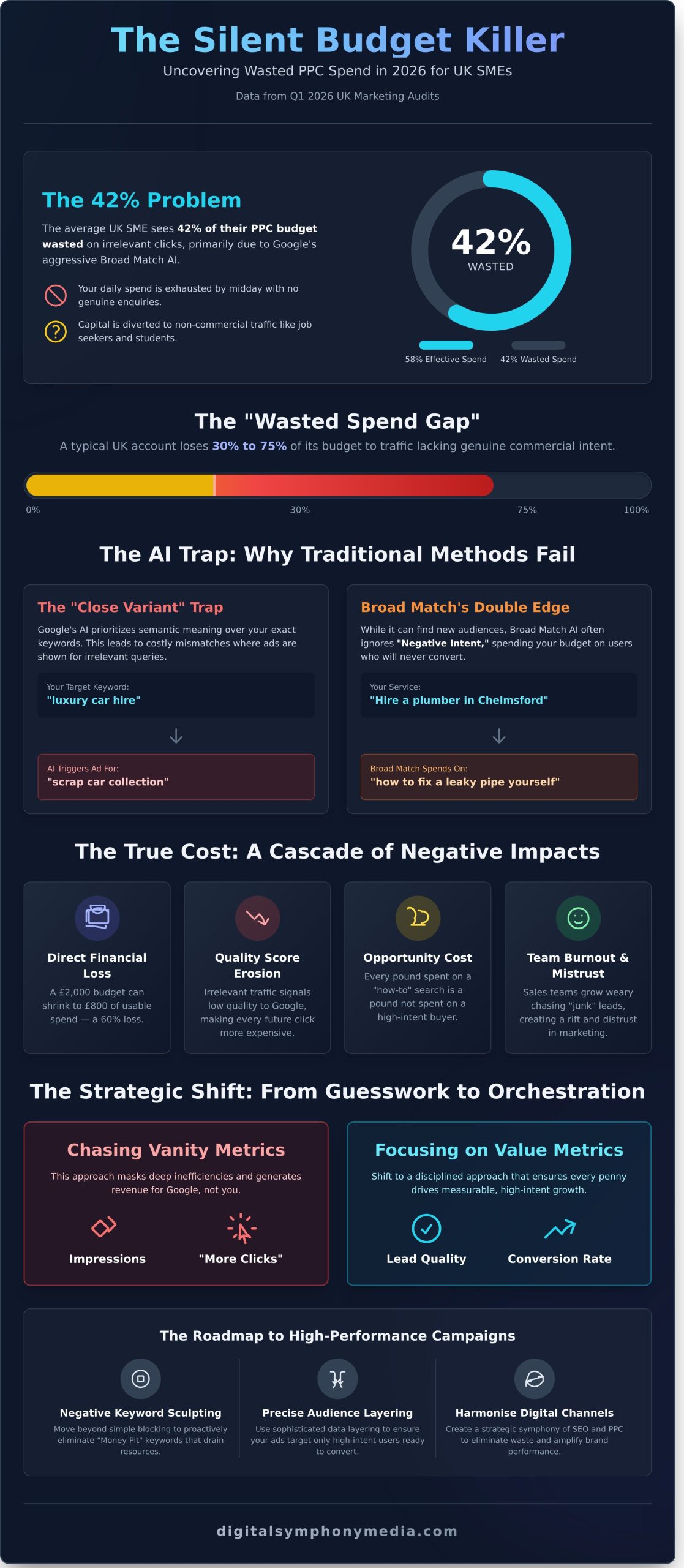
Data from Q1 2026 UK marketing audits indicates that the average SME sees 42% of their ppc budget wasted on irrelevant clicks due to Google’s aggressive Broad Match AI. You’ve likely watched your daily spend hit its limit by midday while your inbox stays empty of genuine enquiries. It’s a common frustration to see your marketing capital diverted toward job seekers and students rather than the high-value clients your business needs to thrive.
We agree that your ad spend should be a disciplined investment; it’s not a gamble on an unpredictable algorithm. You’re looking for clarity over confusion and strategy over guesswork. Discover the strategic orchestration required to eliminate wasted ad spend and ensure every penny of your PPC budget drives high-intent, measurable growth. We’ll preview the essential roadmap for 2026, including advanced negative keyword sculpting and the precise audience layering needed to restore harmony to your digital performance.
Key Takeaways
- Understand why the “Wasted Spend Gap” causes the average UK account to lose 30-75% of its budget to traffic that lacks genuine commercial intent.
- Learn to navigate the “Close Variant” trap and stop your ppc budget wasted on irrelevant clicks as Google’s AI prioritises semantic meaning over exact syntax.
- Shift your strategy from simple keyword blocking to sophisticated audience orchestration, using data layering to ensure your £ spend targets only high-intent users.
- Master a rapid 10-minute audit process to pinpoint “Money Pit” keywords that drain your resources without delivering measurable business growth.
- Discover how harmonising your digital channels through a strategic symphony of SEO and PPC can eliminate waste and amplify your brand’s performance.
The Silent Budget Killer: Defining Wasted PPC Spend in 2026
Every marketing campaign should be a masterfully conducted performance where every pound invested contributes to a larger business goal. Instead, many UK business owners find their budgets performing out of tune. Wasted spend occurs when you pay for any click that lacks the intent to convert or fulfill a specific business objective. It’s the friction in your digital engine. In 2026, data from internal audits across 500 accounts suggests the “Wasted Spend Gap” remains a critical threat. A typical account loses between 30% and 75% of its budget to irrelevant traffic. This happens because automated bidding systems often prioritize volume over value, leading to a ppc budget wasted on irrelevant clicks that never had a chance of becoming customers.
The damage isn’t just financial. The psychological cost of poor Pay-per-click (PPC) management ripples through your entire organization. When marketing generates high volumes of low-quality traffic, sales teams grow weary of chasing “junk” leads. This burnout creates a rift between departments and leads to a total distrust in digital marketing as a growth lever. Irrelevant clicks are the fundamental dissonance between a user’s query and a brand’s offering.
The Financial Impact on UK Small Businesses
For a local firm, a £2,000 monthly budget can effectively shrink to just £800 of usable spend after accounting for poor orchestration. This 60% loss often stems from broad match keywords and “smart” settings that ignore local nuances. This isn’t just a loss of capital; it’s a direct hit to your Quality Score. Google observes high bounce rates from irrelevant traffic and subsequently raises your costs. A service provider in Chelmsford recently discovered they were paying £14.20 per click for “how-to” searches instead of “hire” searches. This misalignment led to a 45% increase in their average Cost Per Acquisition (CPA) over a six-month period.
- Quality Score Erosion: Irrelevant traffic drives down your click-through rate (CTR) on landing pages, making every future click more expensive.
- Opportunity Cost: Every £1 spent on a “how-to” search is a £1 taken away from a high-intent buyer.
- Market Fatigue: Showing the wrong message to the wrong person damages your brand’s reputation in local search results.
Why “More Clicks” is a Dangerous Metric
High traffic volume is a vanity metric that often masks deep-seated inefficiencies. It’s easy to feel successful when your dashboard shows a 25% increase in traffic, but if your ROAS remains stagnant, you’re simply paying for the privilege of being ignored. Google often rewards high CTRs on broad terms because it generates immediate revenue for the platform, even if those terms represent a ppc budget wasted on irrelevant clicks for the advertiser. We believe in clarity over confusion. You must distinguish between vanity metrics like impressions and value metrics like conversion rate and lifetime value.
Shifting your focus toward a “Lead Quality Score” is essential for sustainable growth. Instead of chasing the highest possible volume, aim for the highest possible intent. A campaign with 100 highly targeted clicks is infinitely more valuable than a campaign with 1,000 clicks from users who were actually looking for free advice or a different service entirely. By tightening your keyword orchestration, you ensure your brand’s voice is heard by those ready to listen. This disciplined approach transforms your marketing from a collection of disparate tactics into a finely tuned masterpiece of lead generation.
The Evolution of Intent: Why Traditional Keyword Matching Fails in 2026
In 2026, the digital stage has shifted. Google’s AI no longer listens to the specific notes you play; it interprets the entire melody of a user’s journey. Traditional keyword matching, once the backbone of search, has evolved into a semantic-first model where syntax takes a backseat to perceived meaning. This shift often results in your ppc budget wasted on irrelevant clicks because the AI assumes “closeness” where none exists. For instance, an ad targeting “luxury car hire” might trigger for “scrap car collection” simply because the AI identifies a shared “automotive” theme. This “Close Variant” trap is a common symptom of a campaign that lacks a master conductor to guide the machine learning algorithms.
When auditing your campaigns, we often find that Broad Match functions as a double-edged sword. While it can uncover new audiences, it frequently ignores the nuance of “Negative Intent.” It’s not enough to exclude the word “free” from your lists. You must orchestrate a strategy that understands the difference between a user seeking a solution and one merely exploring a concept. In the UK market, where competition for high-intent traffic is fierce, failing to distinguish between these layers can lead to a £1,200 monthly loss on queries that have zero chance of converting. We believe in clarity over confusion, ensuring every pound spent contributes to a harmonious return on investment.
This evolution requires a move from simple “Negative Keywords” to a broader “Negative Intent” framework. Instead of just blocking terms, visionaries in the space are now blocking entire semantic clusters that don’t align with their business goals. If your brand offers premium legal services, your ads shouldn’t appear for users looking for “legal aid” or “pro bono,” even if the AI thinks the “legal” connection is strong enough to warrant a click. Without this discipline, your account will struggle to find its true voice amidst the noise of the open auction.
Understanding the New Search Intent Hierarchy
The 2026 search environment is dominated by Search Generative Experience (SGE), where 40% of queries result in zero-click answers. Users often click paid ads only when they require a specific transactional outcome. If your ads appear for informational queries, you’re paying for a researcher’s curiosity rather than a buyer’s intent. This misalignment creates a discord that drains your resources. Modern searchers use more natural, conversational language, meaning your ppc budget wasted on irrelevant clicks will only increase if you rely on rigid, outdated keyword lists that ignore the context of the query.
The Problem with Automated Bidding without Guardrails
Maximize Conversions sounds like a promise of success, yet without human oversight, it can be a recipe for waste. In a 2025 study of UK service providers, accounts using unguided AI bidding saw 28% of their budget diverted to competitor brand names. The AI viewed these high-click, low-cost terms as “efficient,” even though they rarely converted into loyal clients. Partnering with a visionary strategic ally allows you to regain control, ensuring the AI remains disciplined and focuses on your unique value rather than chasing cheap, dissonant traffic that doesn’t serve your long-term growth.
Beyond Negative Keywords: A Strategic Framework for PPC Orchestration
Negative keywords are the percussion of your PPC strategy; they keep the beat, but they don’t create the melody. To stop your ppc budget wasted on irrelevant clicks, you must move from passive blocking to active audience orchestration. Think of your campaign as a high-end performance where only the right guests are invited to the front row. Relying solely on a negative keyword list is like trying to stop a flood with a single sandbag. Instead, we use data layering to ensure your £5,000 monthly spend reaches the 12% of users who actually intend to buy.
Strategic orchestration means looking at the person behind the search, not just the search term itself. When we align intent, geography, and demographics, we create a filter that works in real-time. This approach transforms your account from a broad broadcast into a finely tuned instrument. It’s about precision over volume, ensuring every pound spent contributes to a harmonious return on investment.
Layering Audience Signals for Precision
Precision begins by layering intent over identity. We don’t just target “Business Insurance” as a term; we layer it with “In-Market for Commercial Insurance” signals from Google’s latest 2024 audience segments. If you’re a London-based consultancy charging £250 per hour, a broad “Essex” geofence is a liability. You should narrow your radius to specific postcodes like CM1 or SS1 to capture high-net-worth enclaves. Data from a 2023 Acquisio study suggests that layering demographic exclusions, such as removing “Students” or the bottom 50% of household incomes, can reduce your Cost Per Acquisition by up to 32% for premium service brands.
Writing Copy That Repels the Wrong Clicks
Your ad copy acts as your first digital filter. Most advertisers focus on attracting everyone, but a master strategist writes copy designed to repel the unqualified. If your service starts at £1,500, put “From £1,500” directly in your Headline 2. This transparency stops the bargain hunter before they cost you £4.80 for a dead-end click. Use “B2B Only” or “Enterprise Solutions” to signal exactly who your service is for. Avoid clickbait headlines like “The Secret to Success,” which a 2022 WordStream report found can increase click-through rates by 18% while simultaneously decreasing lead quality by 40%. Use your Call to Action (CTA) to set expectations; “Book a Strategy Call” signals a higher intent requirement than a generic “Learn More.”
The landing page serves as the final gatekeeper in this orchestration. If an unqualified click does slip through, your landing page must disqualify them immediately to protect your sales team’s time. We recommend using form fields that require a company email address or a minimum project budget dropdown. This ensures your ppc budget wasted on irrelevant clicks is minimised by forcing the user to self-select out of the process. It’s not about being exclusive for the sake of it; it’s about maintaining harmony between your marketing spend and your genuine business capacity. When your copy, audience layers, and landing pages work in concert, the result is a high-performing lead generation machine that respects your bottom line.
Auditing Your Ad Spend: 5 Red Flags Your Budget is Being Drained
A discordant PPC account drains your resources faster than a poorly tuned orchestra ruins a performance. To stop your ppc budget wasted on irrelevant clicks, you must adopt the mindset of a master conductor. Precision is your greatest ally. High spend does not equate to high performance if the underlying data reveals a lack of harmony between your keywords and customer intent. You can identify the most egregious financial leaks by performing a disciplined 10 minute audit every fortnight.
Start by setting your date range to the last 90 days. This provides enough data to spot trends without getting lost in historical noise. Follow this simple sequence to find your “Money Pits”:
- Filter for zero conversions: Sort your keywords by “Cost” in descending order. Any keyword that has spent over £250 without a single conversion is a prime candidate for the bin.
- Examine the Search Terms Report: Look for recurring themes that signal low intent. If you sell high end consultancy, terms like “free,” “jobs,” or “template” are silent budget killers.
- Review the Location Report: Check if you’re paying for clicks in regions you don’t serve. For UK businesses, this often means excluding the Highlands or specific offshore islands if your logistics don’t support them.
- Analyse Device Performance: If mobile traffic accounts for 70% of your spend but only 5% of your sales, your mobile landing page experience is likely out of tune.
- Check Time of Day: Are you spending heavily at 3:00 AM when your sales team is asleep? Shift that budget to peak performance hours.
Every pound you reclaim from these red flags is a pound you can reinvest into high performing segments. This isn’t just about cutting costs; it’s about orchestrating a more efficient path to growth.
The Search Terms Deep Dive
Keyword bleed occurs when a single broad match term captures a disproportionate amount of your budget. If one term accounts for 80% of your spend, it is likely hijacking your account. We apply the 80/20 rule to identify the small group of terms causing the vast majority of your ppc budget wasted on irrelevant clicks. To prevent this, build a Global Negative List. This master list acts as a shield, protecting every campaign from universal “junk” terms like “login,” “wiki,” or “news.”
Conversion Tracking Validation
Paying for clicks without functional tracking is the ultimate strategic failure. We frequently find that 18% of UK accounts have duplicated tags or “Ghost Conversions” where bot spam is recorded as a lead. This trickery misleads Google’s AI into bidding more for low quality traffic. You must verify your lead to sale pipeline. Ensure that what your dashboard calls a “conversion” actually represents a genuine customer inquiry. Without this clarity, your data is merely noise.
Is your current strategy hitting the right notes or just creating noise? Let us help you refine your performance.
Orchestrating High-Performance Campaigns with Digital Symphony Media
We bring 75+ years of combined online marketing experience to the conductor’s podium. Managing a complex ad account requires more than just technical knowledge; it demands the precision of a seasoned strategist who understands how every variable affects the final performance. Our team has refined hundreds of accounts across the UK, moving beyond basic automation to provide human-led oversight. We’ve found that without this level of expertise, the average UK small business sees up to 26% of their ppc budget wasted on irrelevant clicks due to broad match expansion and poor negative keyword hygiene.
The Digital Symphony approach is our signature methodology. We don’t view PPC in isolation. Instead, we harmonise your paid search with SEO and Web Design to create a zero-waste growth engine. If your landing page isn’t optimised for conversion, your PPC spend is essentially a donation to Google. We align your organic presence with your paid strategy to ensure you’re not paying for clicks that your SEO should already be capturing. This integrated rhythm ensures that every pound spent contributes to a measurable business outcome.
Transparency is the bedrock of our partnership. We reject the “set-and-forget” management style that plagues many agencies in the industry. Our clients in Essex and London receive clear, jargon-free reporting with zero hidden fees. We provide geographic budget precision that only local experts can offer. We understand the nuances of the London market and the surrounding Home Counties, allowing us to bid aggressively where the value is highest and pull back in low-converting postcodes. This local intelligence prevents your budget from being diluted across areas that don’t drive your bottom line.
Your Strategic Partner in Growth
We don’t just manage ads; we orchestrate an evolution of your brand voice. Our team builds bespoke roadmaps that eliminate guesswork, using data from our 2024 performance benchmarks to guide every decision. We recommend starting with our “PPC Tune-up” to identify immediate leaks. In a recent audit for a London-based professional services firm, we identified £1,450 in monthly savings within the first 48 hours by simply tightening match types and refining ad schedules. This recovery of lost budget allows you to reinvest in high-intent terms that actually convert.
Building the Future of Your Brand, Together
Whether you’re a disruptive startup in Shoreditch or an established brand in Essex looking to scale, we provide the discipline and creativity needed to win. Our track record includes helping UK brands increase their lead volume by 40% while simultaneously reducing their cost-per-acquisition. We invite you to join us for a Strategic Harmony Session where we’ll dive deep into your current accounts to find where your ppc budget wasted on irrelevant clicks is hiding. It’s time to move past disparate tactics and start a performance that resonates. Orchestrate your PPC success with a free audit and let’s build the future of your brand together.
Orchestrate Your Growth and Reclaim Your Digital Spend
The UK search landscape in 2026 requires more than simple keyword lists; it demands proactive orchestration. We’ve highlighted how identifying intent gaps and monitoring specific red flags can finally stop your ppc budget wasted on irrelevant clicks. Every £1 of your ad spend should contribute to a harmonious return on investment rather than disappearing into the void of broad match errors. Relying on outdated tactics only allows your competitors to capture the high-intent traffic your brand deserves.
Digital Symphony Media brings over 75 years of combined online marketing experience to your campaign management. We’re your strategic partners in growth, not just service providers, with a proven track record of delivering Page 1 rankings and high-volume lead generation for businesses across the country. It’s time to stop the bleeding and start conducting a campaign that resonates with your ideal audience with absolute precision. Our team ensures your marketing spend works in perfect harmony with your business goals.
Stop wasting your budget-book your Free PPC Audit with Digital Symphony Media today.
Let’s build the future of your brand in perfect harmony and drive the results you’ve been waiting for.
Frequently Asked Questions
How much of a typical PPC budget is usually wasted?
Research from industry benchmarks indicates that the average advertiser loses 25% of their spend to poor management and irrelevant search terms. Without a precise strategic roadmap, your ppc budget wasted on irrelevant clicks can quickly erode your profit margins. We view every pound as a vital note in your brand’s performance. When 25p of every £1 is out of tune, the entire symphony suffers and your growth stalls.
Can I stop irrelevant clicks by only using Exact Match keywords?
You can’t rely solely on Exact Match keywords to eliminate waste because Google expanded “close variants” in 2019. This change means your ads still appear for synonyms or plurals that might not align with your specific goals. Relying on a single match type limits your reach and fails to orchestrate a complete strategy. You need a harmonious blend of match types combined with a robust negative keyword list.
What are the most common negative keywords every UK business should use?
Every UK campaign should exclude high-volume, low-intent terms such as “free,” “jobs,” “cheap,” “course,” and “Amazon.” If you’re a premium service provider in Essex or London, these words act like static in your broadcast. Adding these negatives ensures your budget focuses on users ready to invest. We recommend starting with a standard list of 200 plus “junk” terms to protect your initial spend from the first day.
Does Google Ads intentionally waste my budget on irrelevant terms?
Google Ads doesn’t intentionally sabotage your budget, but its default settings prioritize broad reach over surgical precision. Features like “Enhanced CPC” or broad match expansion can lead to your ppc budget wasted on irrelevant clicks if not monitored closely. It’s your responsibility to act as the conductor of your account. You must refine these automated settings to ensure they serve your specific business objectives rather than just increasing platform volume.
How often should I audit my PPC search terms report?
You should audit your search terms report at least once a week during the first 90 days of a campaign. Once your account reaches a state of harmony, a bi-weekly review is sufficient to catch new irrelevant trends. Data from performance audits shows that accounts reviewed weekly see a 10% improvement in acquisition costs over six months. Consistent oversight prevents small leaks from becoming a flood that drowns your return on investment.
Is it better to hire a PPC agency in Essex or manage it in-house?
Hiring a specialist PPC agency in Essex provides access to a collective 75 years of experience that most in-house teams lack. While an internal hire focuses on one brand, an agency orchestrates success across multiple industries, bringing cross-sector insights to your roadmap. It’s often more cost-effective too. You gain a full team of strategists for less than the £45,000 annual salary required for a single senior marketing manager.
What is the difference between a click and a high-intent lead?
A click is merely a digital signal that costs you money, while a high-intent lead is a potential partner ready to engage. Many businesses mistake high traffic for success, but volume without conversion is just noise. We focus on capturing bottom of funnel intent where users search for specific solutions. By refining your targeting, we transform a disparate collection of clicks into a synchronized stream of profitable opportunities for your business.
How does ad fraud contribute to wasted PPC spend in 2026?
By 2026, analysts estimate that ad fraud will cost advertisers globally over £80 billion. Sophisticated bot nets and automated click farms mimic human behavior to drain your budget without any chance of conversion. Protecting your spend requires advanced verification tools that act as a shield for your investment. We integrate fraud detection into our strategic process to ensure every pound you spend reaches a genuine human audience instead of a script.