
For a small business owner, every pound in your marketing budget must perform. The pressure to choose the right channel can feel immense, creating dissonance rather than harmony in your growth strategy. This leads to the crucial question facing UK entrepreneurs: what is the right move in the seo vs ppc for small business 2026 debate? One promises the steady rhythm of sustainable, long-term growth, while the other offers the powerful crescendo of immediate visibility. Investing in the wrong one can feel like a costly misstep, wasting precious time and resources.
But what if you could orchestrate these two powerful instruments to work in perfect concert? This guide is your definitive roadmap. We move beyond the confusing jargon to give you a clear framework for your decision. You will discover the true costs, realistic timelines, and strategic benefits of each channel, empowering you to confidently invest your marketing budget and compose a symphony of sustainable growth for your business.
Key Takeaways
- Learn to identify the critical business signals that tell you whether to invest your limited budget in the foundational power of SEO or the rapid-fire precision of PPC.
- Discover why SEO is the cornerstone of sustainable growth, building a valuable digital asset that pays dividends long after your initial investment, especially in an AI-driven search landscape.
- The strategic decision of seo vs ppc for small business 2026 often hinges on the need for speed; see how PPC offers immediate, measurable results and invaluable market data for a controlled budget.
- Move beyond the “vs” debate and learn how to orchestrate SEO and PPC in harmony, creating a powerful feedback loop that amplifies your overall marketing performance.
The Overture: Understanding SEO and PPC in Simple Terms
For a small business in the UK, the digital landscape is a stage of immense opportunity. You have ambitious goals for growth, but often a budget that demands every pound be invested with strategic precision. This is the core dilemma when considering seo vs ppc for small business 2026: where do you focus your resources for the greatest impact? Think of your digital marketing as a symphony. To create a masterpiece, you need to understand your instruments. SEO and PPC are two of the most powerful instruments at your disposal.
In this digital symphony, Search Engine Optimisation (SEO) is the foundational arrangement—the patient composition of a timeless piece. It’s about building a permanent, valuable asset that earns trust and draws an audience organically. Pay-Per-Click (PPC), on the other hand, is the soaring crescendo—a targeted, high-impact performance designed to capture attention immediately. It’s about renting prime advertising space for instant visibility. Both are vital, but they play different roles in orchestrating your success.
What is SEO for a Small Business?
Imagine owning your shop on the most desirable high street in town, rather than just renting a pop-up. That’s the power of SEO. The core of Search Engine Optimization (SEO) is the strategic process of improving your website to earn high rankings in unpaid, organic search results on engines like Google. This involves creating valuable content, optimising your site’s technical health, and building your authority online. The goal is to become the trusted, go-to answer when your ideal customers are searching for solutions.
What is PPC for a Small Business?
PPC is your prime-time advertising slot or your impossible-to-miss billboard in Piccadilly Circus. It’s a model of internet marketing where you pay a fee each time one of your ads is clicked. Platforms like Google Ads give you precise control to conduct campaigns targeting specific demographics, locations, and keywords. The primary goal is to drive highly relevant traffic to your website immediately, generating leads and sales from the moment your campaign goes live.
SEO vs. PPC at a Glance
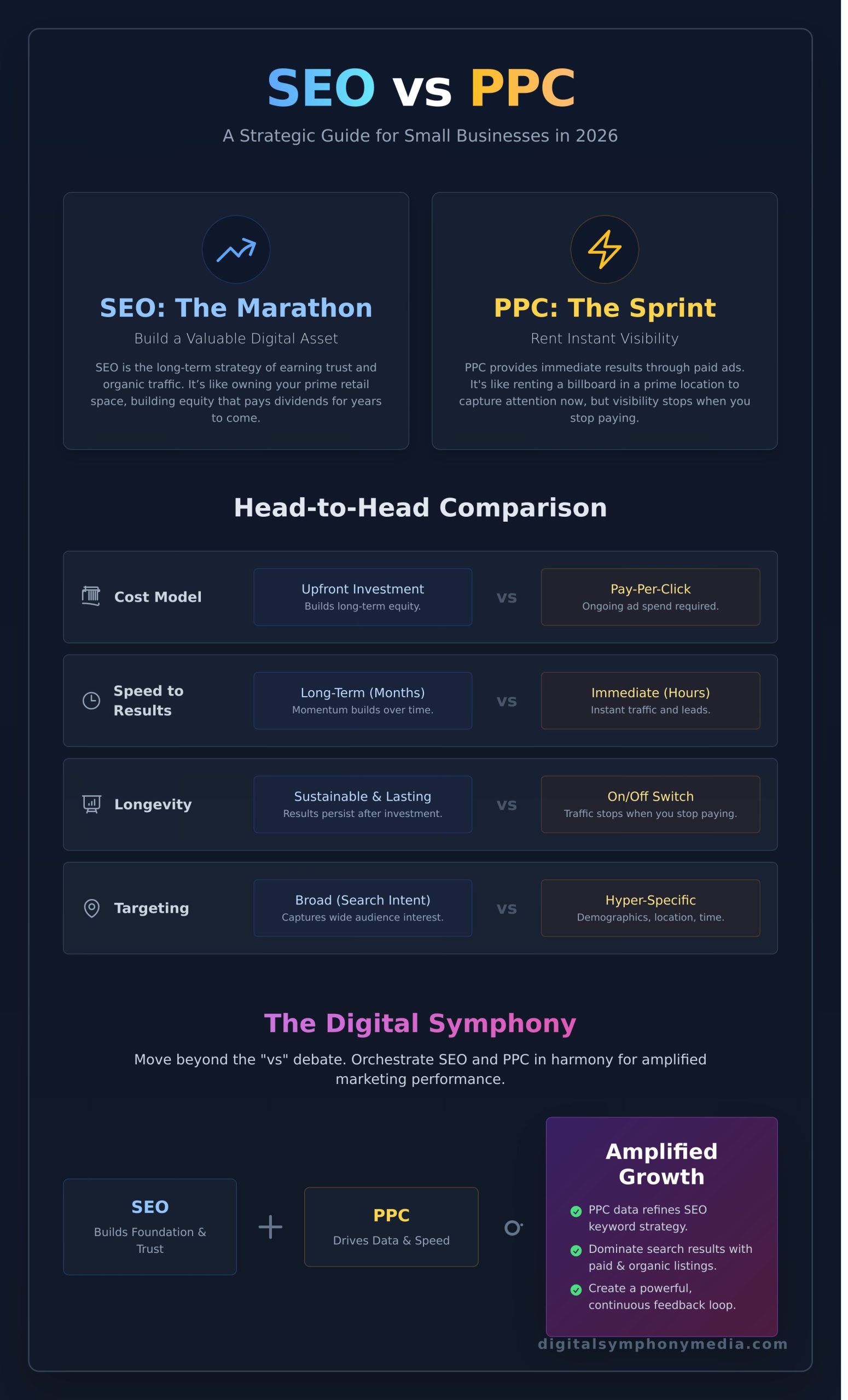
| Feature | SEO (Search Engine Optimisation) | PPC (Pay-Per-Click) |
|---|---|---|
| Cost | Investment in time & resources | Direct payment for each click |
| Speed of Results | Long-term (months) | Immediate (hours/days) |
| Longevity | Sustainable, long-lasting results | Traffic stops when you stop paying |
| Targeting | Broad, based on search queries | Highly specific (demographics, time, location) |
SEO vs PPC: A Head-to-Head Comparison for Budget-Conscious Owners
For a small business owner, every pound in your marketing budget must be orchestrated for maximum impact. The decision between SEO and PPC isn’t just a tactical choice; it’s a strategic one that defines your roadmap for growth, cash flow, and brand perception. Moving beyond generic pros and cons, let’s dissect the tangible business impacts to help you determine the right harmony for your brand. Understanding these core differences is the key to mastering the seo vs ppc for small business 2026 landscape.
Cost Model: Upfront Investment vs. Predictable Ad Spend
Think of SEO as investing in a valuable business asset. It requires a more significant upfront commitment—typically a few thousand pounds for foundational technical SEO, content strategy, and initial optimisation. However, this cost diminishes over time into a smaller retainer for ongoing work. Conversely, PPC operates on a pay-to-play model. The initial setup is less costly, but you must continuously fund your ad budget (e.g., £500 – £2,000+ per month) to remain visible. The moment you stop paying, your traffic disappears. SEO builds equity; PPC rents visibility.
Speed to Results: The Marathon vs. The Sprint
If you need to generate leads immediately, PPC is the undisputed sprinter. A well-configured campaign can place your business at the top of Google search results within hours, driving immediate traffic and enquiries. SEO is the marathon. It is a long-term strategy that builds momentum, often taking 6-12 months to yield significant, authority-building results. The reward for this patience is sustainable, compounding growth—an asset that generates leads long after the initial investment is made, amplifying your brand’s voice organically.
Audience Trust and Click-Through Rate (CTR)
Trust is the currency of the modern web. Studies consistently show that users place more trust in organic results, with some data suggesting organic listings are over 8 times more likely to be clicked than paid ads. This makes SEO invaluable for building brand credibility and capturing users seeking information and solutions. However, PPC excels for high-commercial-intent searches where users are ready to buy now. They see an ad that solves their immediate need and are primed to convert, making it a powerful tool for driving direct sales.
The Crescendo: When to Prioritize SEO for Sustainable Growth in 2026
While PPC delivers immediate tempo, SEO orchestrates the powerful, long-term crescendo of your brand’s growth. It is the strategic foundation upon which you build a valuable, self-sustaining digital asset. As we navigate the evolving landscape of AI-driven search, the central question of seo vs ppc for small business 2026 leans heavily towards authenticity. Search engines are designed to reward genuine expertise and authority, making a robust SEO strategy more critical than ever for building a brand that endures.
SEO isn’t about quick wins; it’s about owning your digital space. It’s the difference between renting an audience through ads and building a loyal community that seeks you out. Here are three scenarios where leading with an SEO-first approach is the definitive roadmap to success.
Scenario 1: You’re a Local Service Business (Plumber, Solicitor, etc.)
For businesses grounded in their local community, from a plumber in Manchester to a solicitor in Bristol, SEO is non-negotiable. The primary goal is to dominate the local map pack and capture intent-driven ‘near me’ searches. A targeted local SEO strategy builds immense trust through:
- A fully optimised Google Business Profile.
- A steady stream of positive customer reviews.
- Consistent business information across UK directories (citations).
This creates a powerful local presence that paid ads alone cannot replicate, turning searchers in your postcode into loyal customers.
Scenario 2: You Have a Tight Budget and a Long-Term Vision
If your marketing budget is measured in hundreds, not thousands, of pounds per month, SEO offers a superior long-term return on investment. While the initial effort is significant, the traffic it generates becomes effectively ‘free’ over time. Every optimised blog post and service page is a digital asset that works for you 24/7, attracting qualified leads long after publication. By focusing on a niche keyword strategy, you can compete effectively and build a growth engine that isn’t dependent on continuous ad spend.
Scenario 3: Your Industry Relies on Expertise and Trust
For consultants, financial advisors, and B2B service providers, trust is the ultimate currency. SEO is the most effective way to demonstrate your expertise at scale. By publishing in-depth guides, insightful articles, and case studies that solve your audience’s core problems, you establish undeniable authority. This strategy shifts the dynamic entirely; instead of chasing clients, they begin seeking your brand by name, viewing you as the definitive voice in your field.
The Quick Tempo: When PPC is the Right Choice for Immediate Impact
While SEO builds the foundational harmony of your long-term digital presence, Pay-Per-Click (PPC) advertising is the dynamic, fast-tempo movement in your marketing symphony. It’s designed for speed, precision, and immediate impact. For a small business, this level of control isn’t just a benefit; it’s a strategic necessity, allowing you to turn visibility on and off like a switch and measure every pound spent with absolute clarity.
PPC is your instrument for:
- Instant Visibility: Appear at the top of Google search results today, not months from now.
- Hyper-Targeting: Reach specific demographics, locations, and user behaviours with surgical precision.
- Validating Ideas: Test a new product or service offering with a modest budget before committing significant resources.
Scenario 1: You’ve Just Launched a New Website or Product
Your new website is live, but waiting for organic traffic to build can feel like an eternity. PPC campaigns can orchestrate your first wave of visitors within hours of launch. This immediate traffic is invaluable for gathering crucial feedback, testing your messaging, and generating those vital initial sales. It effectively bridges the gap, building brand awareness while your long-term SEO efforts gain momentum.
Scenario 2: You Have a Time-Sensitive Offer or Event
From a Black Friday sale to a local workshop or a limited-time webinar, PPC is purpose-built for promotions with a deadline. You can schedule ads to run for a specific period, ensuring your budget is only spent when it matters most. This agility allows you to target users actively searching for your exact offer, amplifying your message at the peak of their interest.
Scenario 3: You’re in a Highly Competitive UK Market
When you’re competing against established giants with years of SEO authority, PPC levels the playing field. It guarantees you a spot on the coveted first page, allowing your brand’s voice to be heard alongside the biggest players. In the complex landscape of seo vs ppc for small business 2026, this ability to instantly claim digital shelf space is a powerful advantage. Paired with remarketing, you can keep your brand in front of potential customers long after their first click.
Ultimately, a well-executed PPC strategy delivers the data and velocity needed to make informed business decisions quickly. To ensure your campaigns are perfectly tuned for success, discover how a strategic partner can help at digitalsymphonymedia.com.
The Digital Symphony: How SEO and PPC Work in Harmony
The debate over SEO vs PPC often misses the most powerful truth: the ultimate strategy isn’t about choosing one instrument, but orchestrating both. For a small business in the UK, viewing these channels as competitors is a missed opportunity. When aligned, SEO and PPC create a powerful feedback loop, with each channel amplifying the other’s strengths and mitigating its weaknesses. This integrated approach transforms your marketing from a series of isolated tactics into a cohesive digital symphony that drives sustainable growth.
Use PPC Data to Fuel a Smarter SEO Strategy
PPC provides immediate data and market insights that can take months to uncover with SEO alone. By running targeted Google Ads campaigns, you can quickly test which keywords convert into actual customers, not just clicks. The winning ad copy from these campaigns provides a proven blueprint for crafting compelling SEO title tags and meta descriptions that resonate with your audience. Furthermore, your PPC search term reports become a goldmine for discovering new, high-intent keyword opportunities to target in your long-term organic strategy.
Boost Your PPC Campaigns with Strong SEO
This relationship is a two-way street. A strong SEO foundation directly enhances your PPC performance. A well-optimised, fast-loading landing page—a core tenet of good on-page SEO—dramatically improves your Google Ads Quality Score. A higher Quality Score is rewarded with lower ad costs and better ad positions, stretching your budget further. Moreover, when a user sees your brand ranking organically, it builds trust and authority, making them more likely to click on your paid ad when they see it.
Dominate the SERP with Maximum Visibility
The ultimate goal of an integrated strategy is complete search engine results page (SERP) dominance. When you appear in both paid and organic listings for your most valuable keywords, you don’t just double your visibility—you create an undeniable impression of market leadership. This synergy allows you to:
- Occupy maximum “digital shelf space,” pushing competitors further down the page.
- Use PPC remarketing to bring back visitors who initially found you through organic search but didn’t convert.
- Create a seamless user journey from initial awareness to final conversion.
The most effective seo vs ppc for small business 2026 framework is not a choice, but a coordinated performance designed for measurable success.
Thinking of your marketing as separate channels means you’re leaving growth on the table. It’s time to conduct a unified strategy where every piece works in concert. Let’s orchestrate your strategy for measurable success.
Conducting Your 2026 Growth Strategy: The Final Note on SEO vs. PPC
The digital marketing landscape isn’t a duel; it’s a symphony. As we’ve explored, SEO composes the foundational melody for long-term, sustainable authority, while PPC provides the powerful, immediate tempo to capture attention and drive conversions. The essential takeaway when considering seo vs ppc for small business 2026 is that the most resonant growth comes not from choosing one, but from understanding how to blend them in perfect harmony.
Crafting this digital symphony requires a seasoned conductor. At Digital Symphony Media, we are strategic partners focused on your measurable success. With over 75 years of combined online marketing experience and a proven track record of generating leads for small businesses across the UK, we know how to make your brand’s voice heard. Don’t leave your growth to chance.
Schedule a free strategy session to orchestrate your business growth. The stage is set for your success; let’s compose a masterpiece together.
Frequently Asked Questions
As a small business, can I do SEO or PPC myself?
While DIY is possible, orchestrating a successful digital marketing campaign is a significant commitment. Mastering the technical nuances of SEO and the bidding strategies of PPC requires dedicated time and continuous learning. For business owners focused on their core operations, partnering with a specialist ensures your marketing symphony is played to perfection, avoiding costly mistakes and accelerating your growth. This strategic partnership allows you to focus on what you do best.
How much should a small business budget for SEO or PPC per month?
In the UK, a meaningful SEO investment typically starts from £750-£1,500 per month for foundational work. For PPC, your budget is split between ad spend and management fees. A starting ad spend of £500-£1,000, plus a management fee, is a realistic entry point. Think of it as commissioning your digital symphony; the investment dictates the scale and impact of the performance, driving measurable success for your business.
Which is better for a brand new business with a new website?
For immediate visibility, PPC acts like a powerful opening fanfare, driving instant traffic to your new website. This allows you to test your messaging and generate leads from day one. Simultaneously, we recommend beginning your SEO strategy. This is the long-term composition that builds your brand’s authority and sustainable organic traffic. A harmonious blend of both is the most effective overture for a new business, creating both immediate impact and future stability.
Is local SEO or local PPC more effective for a brick-and-mortar store?
Both are vital instruments in your local marketing orchestra. Local SEO is your foundation, ensuring you appear consistently in Google Maps and “near me” searches, building long-term trust. Local PPC allows you to amplify your voice with precision, targeting specific postcodes with timely offers or event promotions. For a brick-and-mortar business, using them in concert—SEO for presence and PPC for promotions—drives the most powerful results and footfall.
How long does it really take to see ROI from an SEO campaign?
An SEO campaign builds momentum like a musical crescendo. While you may see early positive signals within 3-4 months, such as improved rankings for less competitive terms, a significant, measurable return on investment typically materialises within 6 to 12 months. This is because SEO focuses on building sustainable authority and trust with search engines, a process that delivers compounding returns and long-term, sustainable growth for your brand.
What are the biggest mistakes small businesses make with SEO and PPC?
The most common misstep in the seo vs ppc for small business 2026 debate is the lack of a cohesive strategy. Many businesses treat them as separate, disjointed tactics rather than two parts of a single marketing symphony. Other critical errors include inconsistent effort, targeting overly broad keywords, and failing to track conversions accurately. This leads to wasted investment and a discordant message, rather than the harmonious growth a well-orchestrated campaign can deliver.