
You see the potential for sustainable, long-term growth that a powerful SEO strategy can deliver. But when you try to explain it, does your boss hear a complex, discordant noise instead of a clear melody of ROI? It’s a common challenge: competing for budget against channels that offer immediate results, and struggling to translate SEO performance into the language leadership understands-revenue and growth. If you’re searching for the right notes on how to convince my boss we need seo, you’ve found your sheet music. It’s time to stop feeling like you’re presenting a weak case and start conducting a powerful conversation.
This guide is your strategic roadmap. We will walk you through a five-step framework designed to orchestrate a compelling, data-driven business case. You’ll learn how to forecast tangible returns, address common objections with confidence, and secure the enthusiastic buy-in needed to amplify your brand’s voice online. Let’s transform your proposal from a hopeful request into an undeniable plan for measurable success.
Key Takeaways
- Learn to reframe your pitch from technical jargon to the C-suite’s language of revenue, market share, and projected return on investment.
- Discover how to use a data-driven audit to build an undeniable case, showcasing precisely where your company is losing ground to competitors online.
- The secret to how to convince my boss we need SEO lies in presenting a complete, data-backed business case focused on financial returns, not just rankings.
- Understand how to de-risk the decision for leadership by proposing a targeted, low-cost pilot project designed to deliver a quick, measurable win.
Start with Why: Frame SEO in a Language Your Boss Understands
The most critical step in figuring out how to convince my boss we need seo is to stop talking about SEO. At least, not in the way you’re used to. Forget rankings, algorithms, and domain authority for a moment. To get executive buy-in, you must speak the language of the C-suite: revenue, market share, and sustainable growth. Before you present a single keyword report, your goal is to reframe the conversation around What is Search Engine Optimization (SEO) and its strategic role as a primary business driver, not just a marketing line item.
Focus on Revenue, Leads, and Customer Lifetime Value (LTV)
SEO is not about chasing vanity metrics; it’s about capturing high-intent customers at the exact moment they are actively looking for your solutions. Unlike interruptive advertising that fights for attention, SEO attracts qualified prospects who have already raised their hands. This direct line to active buyers translates into higher-quality leads, shorter sales cycles, and a tangible impact on your bottom line. These organically acquired customers often exhibit greater loyalty and a higher lifetime value, creating a more profitable and sustainable customer base.
Position SEO as a Competitive Weapon
Your competitors are almost certainly investing in SEO, and every day you don’t, you are conceding valuable territory. Frame organic visibility as the most important digital shelf space in your industry. Each time a competitor outranks you for a critical search term, they are capturing a customer that should have been yours. Ignoring SEO is a strategic decision to give your rivals free access to your potential market share. It’s an abdication of your digital presence, allowing others to control the narrative and the customer relationship.
Build a Sustainable, Long-Term Business Asset
Paid advertising is rented land-the moment you stop paying, your visibility vanishes. SEO, however, builds an owned and appreciating digital asset. Every piece of optimised content and every authoritative backlink is a permanent investment that compounds over time, creating a powerful moat around your business. This well-orchestrated strategy drives brand authority and generates traffic for years, systematically lowering your customer acquisition costs. It’s not an expense; it’s an investment in your company’s long-term digital equity.
Step 1: Gather Undeniable Evidence with a Data-Driven Audit
To orchestrate a compelling argument, you must replace opinions with undeniable data. The first step in answering how to convince my boss we need SEO is to remove subjectivity and present a case built on a foundation of hard facts. Your goal is to build a compelling data-driven marketing strategy that showcases not just where your brand currently stands, but the immense, untapped potential for growth. Fortunately, you can gather the initial score for this performance using free tools like Google Analytics and Google Search Console. This evidence will become the backbone of your entire pitch.
Benchmark Your Current Organic Performance
Begin by creating a clear snapshot of your current reality. This isn’t about finding fault; it’s about establishing a baseline from which to measure future success. Use your analytics to document:
- Current Traffic & Revenue: Note the monthly organic traffic, the number of leads or conversions it generates, and the associated revenue in GBP (£).
- Top Performers: Identify which pages and keywords already bring in the most valuable traffic.
- ‘Striking Distance’ Keywords: Find keywords where you rank on page 2 (positions 11-20). These are quick wins waiting to be amplified with a focused SEO effort.
- Negative Trends: Highlight any decline in organic visibility or traffic over the last year.
Conduct a High-Level Competitor Analysis
Next, turn your attention to the competition. Identify 2-3 key competitors who are clearly succeeding in search. Using the free versions of tools like Ahrefs or SEMrush, you can uncover the valuable keywords they rank for that you don’t. The most powerful metric here is the equivalent ad spend. Frame it clearly: “Competitor X receives organic traffic that would cost us over £20,000 per month to acquire through paid ads. They are getting this visibility for a fraction of that cost.”
Calculate the ‘Cost of Inaction’
This is where you translate data into the language of business impact: lost revenue. By combining your competitor research with your own conversion data, you can create a powerful forecast. Show how much potential revenue you are forfeiting each month by not ranking for high-intent keywords. Connect this directly to business goals, illustrating the number of leads, sales, and strategic opportunities that are being missed. This isn’t just a marketing problem; it’s a direct hit to the bottom line.
Step 2: Develop a Clear, Actionable Strategic Roadmap
A vague request for “more SEO” is easily dismissed. The key to understanding how to convince my boss we need seo is to move beyond the abstract and present a well-orchestrated plan. A strategic roadmap transforms your request from an undefined cost into a measurable investment in sustainable growth. It shows you’ve done your homework, understand the commercial implications, and have a clear vision for generating a return.
This plan doesn’t need to be exhaustive, but it must demonstrate clarity, purpose, and a direct line to business objectives. It’s about showing the ‘what’ and the ‘how’ in a language leadership understands: strategy, resources, and results.
Outline the Core SEO Activities
Break down your proposed strategy into the three core pillars of SEO, connecting each activity to a tangible business outcome. This shows you’re focused on high-impact initiatives first.
- Technical SEO: We will start by improving site speed and resolving critical crawl errors. Goal: Enhance user experience to decrease bounce rates and improve conversion rates.
- On-Page SEO: We will optimise our top 5 service pages for target keywords and user intent. Goal: Increase organic visibility for high-value terms to attract qualified traffic.
- Off-Page SEO: We will initiate a digital PR campaign to earn 2-3 high-authority backlinks. Goal: Build brand authority and trust, which directly boosts search engine rankings.
Define Resource Requirements and Budget
Clearly articulate what’s needed to execute your plan. Presenting options shows strategic thinking. The primary choice is between building an in-house capability or engaging an external partner. An in-house team offers deep brand integration, but recruitment, training, and tool costs (often £200-£500+ per month for platforms like Semrush) can be substantial. Conversely, a specialist partner provides immediate expertise and a proven framework. See how an SEO agency partnership can accelerate results and deliver a faster return on investment.
Establish Timelines and Key Performance Indicators (KPIs)
Set realistic expectations by outlining a clear timeline with measurable milestones. SEO is a marathon, not a sprint, and managing this expectation is crucial. Frame your KPIs to show both early progress and long-term business impact.
- 3 Months (Leading Indicators): Improved keyword rankings for target pages, increase in organic click-through rate (CTR), and a higher Domain Authority score.
- 6-12 Months (Lagging Indicators): Measurable growth in organic traffic, a significant increase in marketing qualified leads (MQLs) from organic search, and ultimately, a demonstrable rise in attributable revenue.
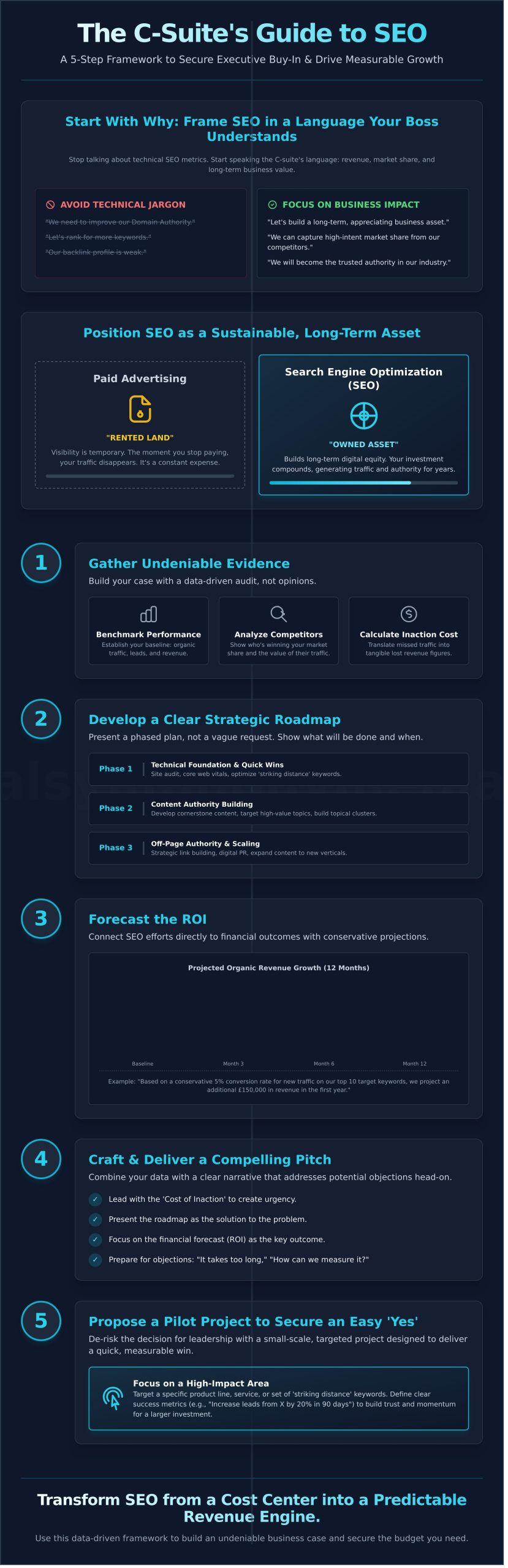
Step 3: Forecast the ROI and Speak the C-Suite’s Language
You’ve outlined the strategy and highlighted the competition. Now comes the most critical movement in your symphony: translating your vision into the language of the C-suite-revenue, growth, and return on investment. This step is the foundation of how to convince my boss we need SEO, moving the conversation from a marketing ‘nice-to-have’ to a business imperative. It directly answers their ultimate question: “What’s in it for us?”
Build a Simple SEO ROI Forecasting Model
Your leadership team thinks in spreadsheets. Presenting a clear, conservative forecast will amplify your message and demonstrate strategic thinking. It’s not about guesswork; it’s about creating a data-driven roadmap for sustainable growth. Follow these steps:
- Select Target Keywords: Choose a small group of 5-10 high-intent, commercially valuable keywords (e.g., “commercial property solicitors Chelmsford”).
- Project Monthly Traffic: Use a simple formula: (Monthly Search Volume) x (Target Click-Through Rate for a top 3 position, ~15%) = Estimated Monthly Visits.
- Estimate New Leads: Apply your site’s current conversion rate: (Estimated Visits) x (Your Conversion Rate, e.g., 2.5%) = Projected Monthly Leads.
- Forecast Revenue: Multiply by your value: (Projected Leads) x (Average Customer Lifetime Value, e.g., £7,500) = Projected Monthly Revenue.
Compare SEO vs. PPC for a True Cost-Benefit Analysis
To orchestrate a compelling argument, contrast the projected Customer Acquisition Cost (CAC) of your SEO strategy with your current paid channels. For example, if your proposed SEO budget is £4,000 per month and you forecast eight new customers, your SEO CAC is £500. How does this stack up against your Google Ads CAC? Highlighting this disparity showcases SEO not as a cost, but as a more efficient, appreciating asset that drives long-term profitability.
Present a Clear ‘Ask’ with a Projected Payback Period
Conclude with a confident and specific request. Frame the budget as a strategic investment with a defined timeline for returns, transforming the conversation from an expense request into a business growth proposal. For example: “We are requesting an initial investment of £24,000 for a 6-month strategic SEO campaign. Based on our conservative forecast, we project a payback period of 9-11 months, after which this channel will generate sustainable, high-margin revenue.”
Step 4: Craft and Deliver a Compelling Pitch
You have gathered the data and identified the opportunity. Now, you must orchestrate this information into a persuasive narrative. The quality of your presentation is as important as the data itself; it transforms you from a marketer with a request into a strategic business driver with a plan for growth. The core of how to convince my boss we need SEO lies in presenting a clear, confident, and data-backed business case that speaks directly to their priorities: revenue, market share, and long-term stability.
Structure Your ‘Business Case for SEO’ Presentation
A well-structured pitch creates a logical and compelling flow, guiding your boss from the current problem to the profitable solution. We recommend a concise, four-part structure that respects their time and focuses on business outcomes.
- The Executive Summary: Start with a single, powerful slide. State the problem (e.g., “We are losing £X in potential revenue to competitors online”), the solution (a strategic SEO programme), and the ask (the required budget).
- The Opportunity & Cost of Inaction: Use your audit data to visualise the market share you are currently conceding. Frame it clearly: “Continuing without SEO means we are actively choosing to ignore X% of our target market.”
- The Strategic Roadmap: Present a clear timeline, budget breakdown, and key performance indicators (KPIs). This demonstrates foresight and shows you have a disciplined plan, not just an idea.
- The ROI Forecast: Conclude with the most important part-the projected return on investment. Present a conservative and an optimistic forecast based on your traffic and conversion data, and ask for a clear decision.
Prepare for Common Objections
A true strategist enters the room prepared for scrutiny. Anticipate potential objections and have thoughtful, data-supported responses ready to build confidence and overcome hesitation.
For “SEO takes too long to show results,” agree but reframe. Explain that while significant results take time, you will track leading indicators like ranking improvements and organic visibility from month one. Position SEO as building a valuable, long-term digital asset that, unlike paid ads, continues to deliver value even after the initial investment.
If you hear, “We tried SEO before and it didn’t work,” acknowledge their past experience. Then, clearly articulate what makes your plan different. Is it a more comprehensive strategy, better resources, or a focus on commercial-intent keywords? Show them this is a new, more sophisticated symphony, not a repeat performance.
Finally, for “The ROI is uncertain,” be transparent. Acknowledge that these are projections, but emphasise they are grounded in competitor performance, market data, and your own historical conversion rates. This honesty builds trust and shows you are a credible business partner. If you need help crafting a pitch that resonates, our team at Digital Symphony Media can help you orchestrate a winning proposal.
Step 5: Propose a Pilot Project to Secure an Easy ‘Yes’
You’ve presented the data, outlined the strategy, and shown the competitor landscape. Yet, the final budget approval remains elusive. If you’re still wondering how to convince my boss we need SEO on a grand scale, it’s time to change the composition. Instead of asking for the entire orchestra, propose a quartet-a focused, high-impact pilot project.
This approach masterfully de-risks the decision for leadership. It reframes the conversation from a significant upfront investment to a calculated, low-cost test. By suggesting a pilot, you demonstrate strategic thinking and fiscal responsibility, positioning yourself not as a mere advocate but as a prudent business partner invested in measurable success.
How to Define a High-Impact Pilot Program
The key to a successful pilot is precision. This isn’t a broad, sweeping campaign; it’s a surgical strike designed for maximum impact with minimal resources. A well-defined pilot has a clear, narrow focus and undeniable metrics. We recommend structuring it with the following components:
- A Specific Target: Isolate one high-margin service, a single product line, or a key geographic area in the UK where you want to prove traction.
- Laser-Focused Keywords: Target a small set of high-intent, bottom-of-the-funnel keywords. Think “emergency plumber in Manchester” not “plumbing tips.”
- Clear Success Metrics: Define what success looks like from the start. This could be a 20% increase in qualified leads from organic search or achieving page-one rankings for five core keywords within a 3-6 month timeline.
The ‘Land and Expand’ Strategy
A pilot project is the first movement in a larger symphony of growth. The goal is to create a repeatable success model-a case study written with your own company’s data. When you can return to your boss in six months with a clear, positive ROI, the conversation shifts from “Should we do SEO?” to “How quickly can we scale this success across other business units?” This ‘land and expand’ approach builds internal trust and creates undeniable momentum, proving SEO’s power one victory at a time.
This isn’t just a test; it’s the overture to sustainable, long-term growth. By proving the concept, you create the internal harmony needed to amplify your brand’s voice across the entire digital landscape. Let’s orchestrate a pilot project for your business.
Orchestrate Your Pitch for a Standing Ovation
The journey from proposal to approval is a strategic performance. Moving beyond technical details, this guide has shown that the answer to how to convince my boss we need SEO lies in speaking their language: the language of data, ROI, and sustainable growth. By presenting undeniable evidence from an audit and a clear, actionable roadmap, you transform a simple request into a compelling business investment that is impossible to ignore.
Crafting this narrative requires precision and expertise. As strategic partners, not just service providers, we specialise in translating SEO opportunities into measurable business outcomes. With a proven track record and over 25 years of combined experience generating leads and growth for UK businesses, we help you build the perfect composition. Ready to build your winning case? Let’s orchestrate your SEO strategy together.
The stage is set. It’s time to take your well-researched case and secure the investment your brand deserves.
Frequently Asked Questions
How do I explain SEO to my boss who isn’t technical?
Think of your website as your brand’s voice in a vast digital concert hall. SEO is the process of orchestrating all the right signals-from your website’s content to its technical structure-so that search engines like Google can hear you clearly. It ensures that when your ideal customer asks a question, your voice is the first one they hear. It’s about being found, not just being present, and turning searchers into customers.
What are the most important metrics to show my boss to prove SEO value?
Focus on metrics that orchestrate business growth. Instead of just keyword rankings, present the increase in organic traffic and, more importantly, the organic conversion rate. Show the number of qualified leads or sales generated directly from search. Tying SEO efforts to bottom-line results like customer acquisition cost (CAC) and revenue is the most powerful way to demonstrate its strategic value and amplify your business’s success.
How long does it really take to see meaningful results from SEO?
SEO is a strategic investment in sustainable growth, not an overnight tactic. While some initial improvements can be seen in 3 to 6 months, a truly impactful performance takes time to orchestrate. Think of it as composing a symphony; each element builds on the last. For competitive industries in the UK, expect to see significant, measurable results that impact your bottom line within 6 to 12 months of consistent, strategic effort.
What if we don’t have a big budget? Can we still do effective SEO?
Absolutely. A grand symphony can begin with a single, powerful instrument. For smaller budgets, focus is key. Start by orchestrating a flawless technical foundation and dominating your local search landscape with a strong Google Business Profile. Prioritise creating high-value content for a specific niche audience. A strategic, focused approach can deliver a significant return, even with a modest investment starting from a few hundred pounds per month for foundational work.
Is SEO still relevant with the rise of AI and social media?
More than ever. AI is becoming part of the search engine, making user intent and high-quality content paramount-the very core of modern SEO. Social media and SEO work in harmony; social signals can amplify your content’s reach, driving traffic and brand authority that search engines reward. SEO remains the foundational strategy for capturing high-intent customers who are actively searching for the solutions you provide, making it an essential part of any digital symphony.
How do I choose between hiring an SEO agency and building an in-house team?
This choice depends on your vision and resources. An in-house team offers deep brand immersion but requires significant investment in salaries (a skilled UK SEO Manager can command £40k-£60k+), training, and tools. An agency provides an orchestra of specialists and technology for a consolidated fee. Presenting this cost-benefit analysis is a crucial step in figuring out how to convince my boss we need seo with a clear, strategic roadmap.