
Choosing a digital marketing agency can feel like trying to conduct an orchestra without a score. You’re faced with a cacophony of impressive pitches and bold promises, but how do you distinguish true harmony from mere noise? To orchestrate genuine success, you need more than just a vendor; you need a strategic partner who understands your vision. The key to finding this partner-and avoiding costly, dissonant relationships-lies in knowing the essential questions to ask a digital marketing agency before you sign any contract.
This guide is your definitive roadmap. We’ve compiled the 21 crucial questions designed to cut through the jargon and reveal an agency’s true capabilities and strategic depth. Consider this your conductor’s baton, empowering you to lead the conversation with confidence, evaluate potential partners effectively, and choose an ally who will work in harmony with your team to amplify your brand’s voice and drive measurable, sustainable growth.
Key Takeaways
- Move beyond surface-level tactics. Discover how to assess an agency’s business acumen to ensure they can operate as a true strategic partner, not just a service provider.
- A great strategy requires flawless execution. Uncover an agency’s internal processes, team expertise, and communication style to guarantee a smooth and collaborative partnership.
- Demand clarity on results. This guide provides the critical questions to ask a digital marketing agency to cut through vague metrics and ensure reporting demonstrates a tangible return on investment.
- Protect your investment from the start. Learn to identify common red flags and understand contractual terms to enter a new partnership with confidence and clear expectations.
Part 1: Questions About Strategy and Business Acumen
Before you dive into the specifics of SEO, PPC, or social media tactics, you must first gauge an agency’s business acumen. A collection of services without a unifying strategy is merely noise, not a symphony. The goal is to find a strategic partner who understands your commercial landscape, not just a vendor who can execute tasks. The most crucial questions to ask a digital marketing agency are those that reveal how they think, plan, and align their efforts with your core business objectives.
A truly great agency will be as inquisitive as you are. They understand that a successful partnership is built on a shared understanding of the challenges and opportunities ahead. Their questions will demonstrate a genuine desire to orchestrate a bespoke roadmap for your growth.
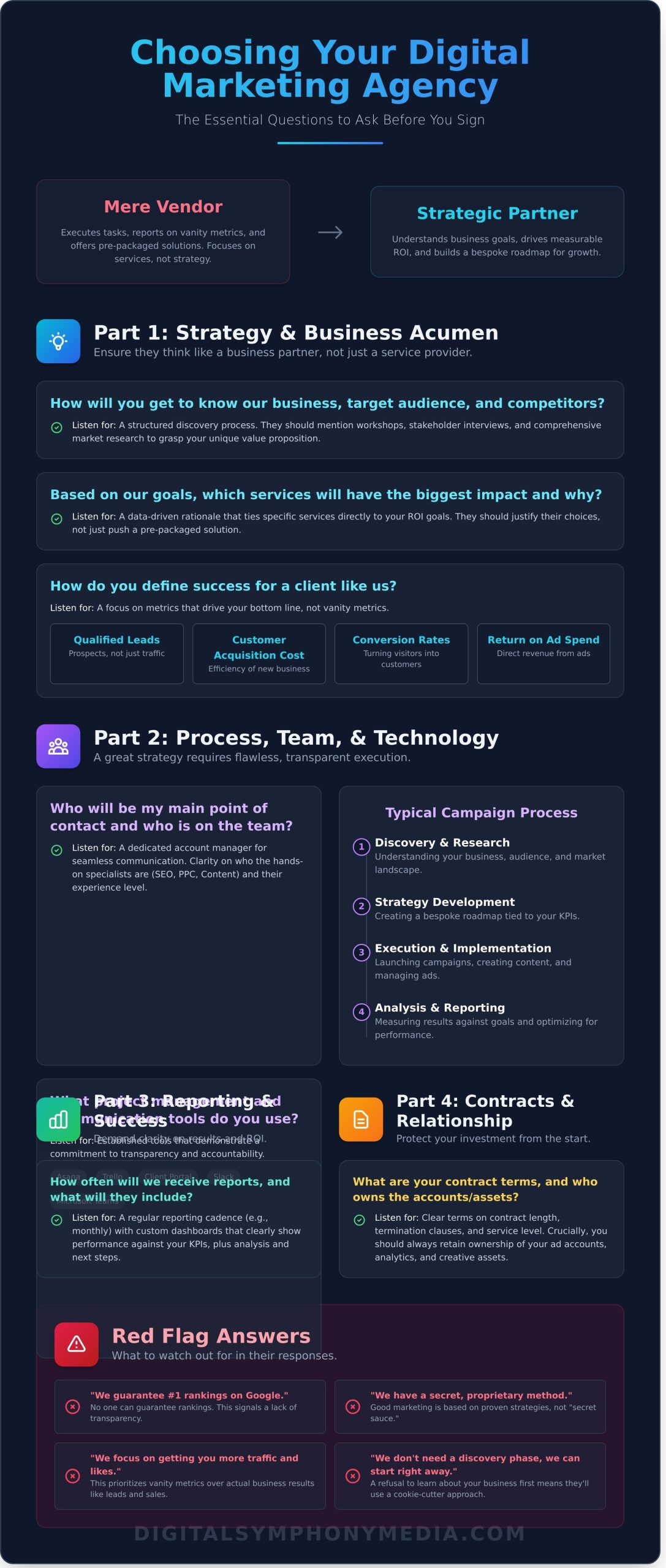
How will you get to know our business, target audience, and competitors?
A masterful performance requires a deep understanding of the composition. Listen for a structured discovery or onboarding process. A potential partner should describe a methodical approach involving workshops, stakeholder interviews, and comprehensive market research. Their goal should be to fully grasp your unique value proposition, ensuring every marketing note they play resonates perfectly with your ideal customer and positions you distinctly against your competitors.
Based on our goals, which services will have the biggest impact and why?
This question separates the strategic conductors from the service resellers. A true partner understands that the vast field of Digital marketing offers many instruments, but only a select few are needed to create the right harmony for your specific goals. They should be able to justify their recommendations with data, case studies, or a clear, logical rationale tied directly to ROI. Beware of any agency that pushes a pre-packaged solution or a single service for every business problem.
How do you define success for a client like us?
The final applause should be measured in revenue, not just reach. Their answer must transcend vanity metrics like ‘traffic’ or ‘likes’ and focus on the key performance indicators (KPIs) that drive your bottom line. Look for a commitment to tracking and improving metrics such as:
- Qualified Leads Generated
- Customer Acquisition Cost (CAC)
- Conversion Rates
- Return on Ad Spend (ROAS)
Success should be a shared definition, a tangible result that contributes to your sustainable growth.
Part 2: Questions About Their Process, Team, and Technology
A visionary strategy is the composition for your brand’s success, but it’s useless without a skilled orchestra to perform it. A disciplined process is what transforms ambitious goals into measurable results. The following questions to ask a digital marketing agency are designed to look behind the curtain, revealing how they orchestrate their work day-to-day. Gaining clarity here is crucial for building a harmonious partnership and preventing future communication breakdowns.
Who will be my main point of contact and who is on the team?
Understanding the team structure is vital. Will your primary contact be a dedicated account manager focused on client relations, or the lead strategist executing the work? A dedicated point of contact ensures seamless communication. It’s also wise to ask about the experience level of the specialists-the SEO analysts, content creators, and PPC managers-who will be hands-on with your account. You are hiring the entire ensemble, not just the conductor.
What project management and communication tools do you use?
A professional agency operates within a structured ecosystem. Look for mentions of established project management tools like Asana, Trello, or a bespoke client portal. For communication, platforms like Slack or Microsoft Teams indicate an organised approach to daily collaboration. These systems aren’t just about software; they demonstrate a commitment to transparency, accountability, and keeping your project on schedule and in tune.
Can you walk me through your process for a typical campaign?
An agency should be able to clearly articulate the key phases of their work. This roadmap typically includes discovery and research, strategy development, execution and implementation, and finally, analysis and reporting. While the core process is often similar, the specifics can vary. For instance, the critical questions for an e-commerce marketing agency will focus heavily on platform integration, which differs from a B2B lead generation campaign. This insight reveals their strategic depth and helps you visualise the partnership.
How much work do you outsource to freelancers or other agencies?
It’s common for agencies to collaborate with trusted specialists, like bringing in a guest soloist for a specific part. Transparency is non-negotiable. An agency should be open about what, if any, work is outsourced and how they maintain quality control with their partners. Ultimately, you need to know who is responsible for the final performance and ensuring every element of your digital symphony works in perfect harmony.
Part 3: Questions About Reporting and Measuring Success
A beautifully orchestrated campaign is meaningless if it doesn’t drive tangible results. This is where accountability is forged and your return on investment (ROI) is proven. Among the most critical questions to ask a digital marketing agency are those that define how success is measured and communicated. Vague, inconsistent reporting is a major red flag; a true strategic partner is eager to show you the data behind their performance and connect every marketing action to your business’s bottom line.
What metrics do you track and how often will we receive reports?
Your agency should provide comprehensive reports at least monthly. The key is to ensure they track Key Performance Indicators (KPIs) that are in harmony with your specific business goals-such as cost per acquisition, conversion rate, and customer lifetime value. Be wary of agencies that focus on “vanity metrics” like impressions or likes, which don’t always translate to growth. Always ask to see a sample report to gauge its clarity, depth, and focus on meaningful data.
How do you present results? Is it just a data dump or an analysis?
Numbers without narrative are just noise. A great report is more than a spreadsheet; it’s a strategic analysis that provides insights and a clear roadmap for the future. A truly strategic approach, as outlined in foundational resources like the SBA’s marketing and sales guide, is about connecting every action to a business objective. Your agency should be able to answer the “so what?” behind the data, explaining what the trends mean for your business and outlining the next strategic steps.
What happens if a campaign is not meeting its goals?
Even the best-laid plans require adjustments. This question reveals an agency’s character and problem-solving skills. A strong partner won’t make excuses. Instead, they will demonstrate a proactive mindset that involves a deep-dive analysis to understand the issue, a commitment to testing new variables, and the agility to make strategic pivots. They should take ownership of the performance, communicate their plan for improvement clearly, and view challenges as opportunities to refine and strengthen the overall strategy.
Part 4: Questions About Contracts and the Client Relationship
A successful marketing strategy is more than just a series of tactics; it’s a harmonious partnership built on clarity and trust. Before you sign any agreement, it’s vital to clarify the terms of engagement to ensure both parties are perfectly in sync. These questions about contracts and communication are designed to build a strong foundation, preventing future dissonance and orchestrating a long-term, successful relationship. A truly transparent agency will welcome these discussions as part of composing a successful partnership-a principle we champion at Digital Symphony Media.
What are your contract lengths and payment terms?
Understanding the financial and time commitment is fundamental. Most UK agencies work on monthly retainers with contracts typically lasting 6-12 months, as this timeframe is necessary to generate and prove a meaningful return on investment. Ask if they offer shorter trial periods or more flexible rolling contracts. It’s also one of the most important questions to ask a digital marketing agency: what exactly is included in your monthly fee? Clarify all potential extra costs, such as:
- Advertising spend (e.g., Google Ads, social media ads)
- Specialist software or tool subscriptions
- Stock photography or video licensing fees
- One-off project work outside the retainer scope
Finally, ensure you understand the notice period and any clauses related to early contract termination to protect your business.
How do you handle client communication and feedback?
The rhythm of your collaboration is set by communication. A strategic partner doesn’t work in a silo; they work in concert with you. Inquire about their communication structure: Will you have a dedicated account manager? What is the frequency and format of meetings and reports? A great agency views feedback not as a critique, but as essential input to refine the performance. They should have a clear, efficient process for campaign approvals and creative revisions, ensuring your brand’s voice is amplified correctly.
Can you provide references or case studies from similar clients?
Past performance is the strongest indicator of future success. Case studies are the tangible proof of an agency’s ability to orchestrate growth, showcasing their strategic thinking and measurable results. Go a step further and ask to speak with a current or former client, preferably from a similar industry. This provides an unvarnished perspective on the day-to-day reality of working with them. Ask references about the agency’s proactivity, problem-solving skills, and whether the results matched the initial proposal. A confident agency will be proud to share their success stories.
Bonus: Red Flag Answers and What They Really Mean
When you’re armed with the right questions to ask a digital marketing agency, you’re halfway there. The other half is learning to interpret the answers-and the silences. Sometimes, what an agency doesn’t say, or how they deflect a question, is the most revealing part of the conversation. Trust your intuition, but also be on alert for these common red flags. Recognising them can be the difference between a harmonious partnership and a costly hiring mistake.
The ‘Secret Sauce’ or ‘Guaranteed Results’ Promise
If an agency promises a guaranteed #1 ranking on Google or speaks of a ‘secret sauce’ they can’t explain, proceed with caution. This often means they lack a transparent, repeatable process. True digital growth isn’t magic; it’s a symphony of data-driven strategy, consistent execution, and expert analysis. Look for a partner who can articulate their methodology, not one who relies on mystical claims.
Vague Answers About Team and Process
When you ask who will be working on your account or what their exact process is, you need a clear answer. Vague responses can signal a disorganised internal structure or a heavy, undisclosed reliance on transient freelancers. You’re not looking for chaos; you’re looking for a well-oiled machine. A professional agency will proudly explain how their team orchestrates success and the specific roadmap they’ll follow for your brand.
Blaming Past Clients or Other Agencies
Listen carefully to how they speak about previous engagements. An agency that blames former clients, previous agencies, or external factors for a lack of results is demonstrating a critical lack of accountability. A true strategic partner takes ownership of challenges and focuses on solutions. This blame-shifting attitude is a strong indicator that you could be next on their list if obstacles arise.
High-Pressure Sales Tactics
A consultation should feel like a strategic discussion, not a high-pressure sales pitch. If you feel rushed, are offered a ‘today only’ discount, or are pushed to sign a contract before your questions are fully answered, it’s a sign their priority is the sale, not the partnership. A genuine partner is invested in ensuring the relationship is a mutual fit for long-term, sustainable growth. Let’s have a partnership conversation, not a sales pitch.
Orchestrating the Perfect Partnership
Choosing a digital marketing agency is a pivotal decision for your brand’s growth. It’s not about ticking boxes; it’s about finding a true partner who can align with your vision and drive tangible results. By focusing on an agency’s strategic thinking, their transparency, and how they measure success, you can move beyond superficial pitches. Armed with the right questions to ask a digital marketing agency, you are now equipped to distinguish a simple vendor from a dedicated ally.
At Digital Symphony Media, we welcome this level of scrutiny because we believe in clarity and collaboration. We don’t offer one-size-fits-all solutions; we compose bespoke strategies designed for measurable success and a tangible ROI. Our experienced team is ready to act as your strategic partner, working in harmony with you to amplify your brand’s voice and achieve sustainable growth.
Your brand deserves more than just marketing; it deserves a masterpiece. Ready to find a true strategic partner? Let’s orchestrate your brand’s success.
Frequently Asked Questions
How much should I expect to pay for a digital marketing agency in the UK?
In the UK, the investment for a digital marketing agency varies based on the scope and ambition of your goals. For focused projects, retainers often start from £1,000 to £3,000 per month. A more comprehensive, multi-channel strategy typically ranges from £3,000 to £7,000+. For a fully orchestrated, enterprise-level digital symphony, expect to invest upwards of £7,000. True value lies in a strategic partnership that drives measurable, sustainable growth for your investment.
What is the difference between hiring an agency vs. a freelancer or an in-house team?
An agency provides an entire orchestra of specialists-from SEO analysts to content creators-harmonised under a single strategic vision. This offers broader expertise and scalability compared to a freelancer, who excels in a specific niche. An in-house team provides deep brand immersion but often comes with higher overheads and a narrower skill set. Choosing an agency means securing a strategic partner dedicated to orchestrating all facets of your digital presence for maximum impact and growth.
How long does it typically take to see results from digital marketing?
The timeline for results varies with the chosen channels. Paid media campaigns can generate initial traffic and leads within weeks. However, orchestrating sustainable growth through SEO and content marketing is a strategic crescendo; you can expect to see meaningful momentum and measurable traction within 3 to 6 months. We believe in building a powerful, lasting market presence, not just chasing short-term metrics. True success is a marathon, not a sprint.
What should be included in a standard digital marketing agency contract?
A transparent contract is the foundation of a strong partnership. It should clearly define the scope of work, outlining specific services and deliverables. Key components include measurable KPIs to track success, a detailed reporting schedule, the contract duration, clear payment terms, and a fair termination clause. This document serves as the roadmap for our collaboration, ensuring every action is aligned with your strategic goals and that our accountability is never in question.
Is it better to hire a specialist agency (e.g., just SEO) or a full-service agency?
This choice depends on your strategic objective. A specialist agency is like a solo virtuoso, offering deep expertise in a single discipline like SEO. This is ideal if you have a specific, isolated need. However, a full-service agency acts as a complete symphony, orchestrating all digital channels to work in harmony. This integrated approach ensures a cohesive brand message and drives more powerful, holistic growth across your entire digital footprint, amplifying your brand’s voice effectively.
What are the most important qualities to look for in a digital marketing agency?
When considering the essential questions to ask a digital marketing agency, focus on finding a true strategic partner. Look for a proven track record of measurable success, showcased through transparent case studies and client testimonials. Prioritise an agency that communicates clearly and proactively, outlining a strategic roadmap rather than just a list of tactics. Ultimately, the best partner is one whose expertise and values resonate with your own, creating a cultural harmony that drives ambitious results together.